Cacciucco
Cacciucco: history, origins and curiosities of Tuscany's king dish
The history of cacciucco, the most famous fish stew in Tuscany. Origins, curiosities and why it is the symbol of Tuscan coastal cooking.
What is cacciucco: the definition you do not expect
Defining cacciucco is more complicated than it seems. It is not a fish soup. It is not a brodetto. It is not a seafood ragù, although something of that density and that patience in cooking is genuinely present. Cacciucco is a dish that exists autonomously, with its own rules, a precise history and a character that no other seafood first course in Italy has ever been able to claim.
The first thing that strikes you when you taste it for the first time is the consistency of the broth. It is not a liquid - it is almost a sauce, dark red, dense with tomato and that ferrous and briny flavour that only the rock fish of the Tyrrhenian Sea can produce. Then there are the fish, whole or in pieces, arranged over the slice of toasted bread rubbed with garlic that separates them from the bottom of the bowl. The bread is not an accessory - it is a structural part of the dish, absorbs the broth, transforms, becomes something new.
The name itself is a subject of debate among linguists and food historians. Some link it to the Turkish küçük, meaning small, indicating the small fish of the Livornese seabed. Others derive it from the Genoese caçiucò, a seafaring term from the Ligurian area. The truth is that cacciucco has roots so deep in the port of Livorno as to make finding the precise etymology almost irrelevant - what matters is that this word, in Tuscany, needs no explanation.
The origins: Livorno, the port and the fishermen
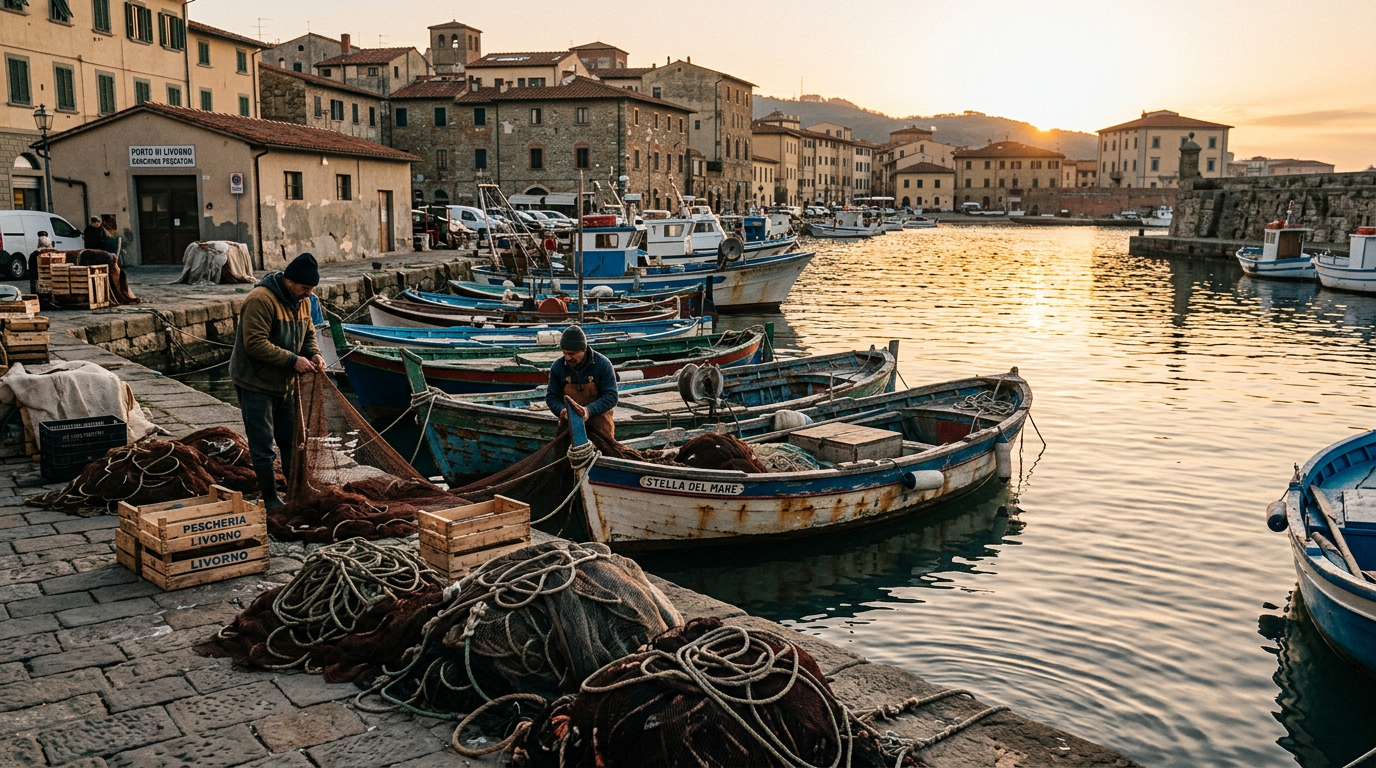
Livorno is a city that cannot be understood without its port. Founded as a new city by the Medici in the late sixteenth century, it became in a few decades one of the most cosmopolitan ports in the Mediterranean - Greeks, Jews, Armenians, Turks, English, and Dutch mixed in its streets and, above all, at its docks. That mixture of cultures was reflected in the cuisine, and cacciucco is the most evident product of that contamination.
The Livornese fishermen - the so-called bottomari, who worked the shallow seabeds - brought to shore every morning what they found: slipper lobster, scorpionfish, moray eel, octopus, cuttlefish, crabs, conger eel. Fish that no market would buy at normal prices, fish considered waste, fish with too many spines or an unsettling appearance. What to do with them? The answer was the big pot, the seawater, the tomatoes from the surrounding fields, the red wine that softens strong flavours. From that practical necessity was born one of the most complex preparations in Italian cooking.
The first written recipe for cacciucco appears in nineteenth-century recipe books, but it is clear that it was already a dish codified by generations. The Tuscan cookbooks of the early twentieth century describe it with the same precision and the same warnings found today: the broth should be made separately with the lower-grade fish, the cooking must be slow, the best fish should be added last.
The legend of the seven Cs: truth or myth?
Ask someone from Livorno how many Cs are in cacciucco and they will answer without hesitation: five. The word cacciucco is spelled with five Cs, and each C must correspond to a variety of fish. Ask the person next to them and they will say seven. Ask an old fisherman and they will probably look at you with benevolent condescension and say that the Cs are not counted, they are cooked.
The legend of the seven Cs is probably a later construction - a colourful way to remember that an authentic cacciucco must incorporate many varieties of fish, not just one. The number varies according to family tradition, season, and market availability. What remains fixed is the principle: more species, more depth of flavour.
Some Cs are non-negotiable: scorpionfish for the broth, octopus for texture, cuttlefish for the ink and sweetness. Then come the additions that change according to the catch: slipper lobster, conger eel, moray eel, smooth-hound, red mullet, sea robin. Every Livornese family has its own list, guarded with the same jealousy as a family secret.
Tuscan cacciucco vs fish soup: the differences
The confusion between cacciucco and a generic fish soup is understandable but unfair. The differences are structural, not superficial.
A fish soup is made with whole or filleted fish, in a more or less light broth, possibly with vegetables. Cacciucco, on the other hand, starts from a soffritto-tomato base that is cooked for a long time before the fish is touched - almost like a vegetable ragù to which fish is then added in successive stages, starting with what requires the most time (octopus, cuttlefish) and finishing with the most delicate (slipper lobster, prawns if available). The cooking is long - not less than an hour and a half for a well-made cacciucco - and the broth reduces, concentrates, becomes dense.
Then there is the bread. In cacciucco the toasted garlic-rubbed bread is part of the dish, not an accompaniment. It is placed at the bottom of the bowl and the cacciucco is poured over it. The bread absorbs the broth and transforms - it is no longer bread, it is not yet soup, it is something of its own.
Finally, there is the red wine in the cooking. Many Italian fish stews use white wine. Cacciucco uses red - typically a Morellino or a young Chianti - which gives that tannic and earthy note that balances the sweetness of the tomato and the intensity of the rock fish.
Why cacciucco remains irreplaceable today
In an era when many dishes of Italian regional cooking have been standardised, cacciucco remains stubbornly different from restaurant to restaurant, from family to family. There is no official deposited recipe, no production protocol - and this is its strength.
The variability of the Tyrrhenian catch, which changes with the seasons and the luck of the fishing, means that no two cacciuccos are alike. The January version, with more conger eel and moray available, has a different flavour from the August one, when slipper lobster and mantis shrimp arrive. The one prepared with fish caught that morning has a freshness and delicacy that cannot be replicated with frozen products, however good.
It is a dish that requires time, attention and a certain generosity of ingredients. It cannot be improvised. It cannot be rushed. And for this reason, in the restaurants that make it really well, it is often the dish that distinguishes those who work with care from those who work from mere habit.
Alcide’s cacciucco: Tyrrhenian fish in the Tuscan interior
At Ristorante Alcide in Poggibonsi, at the heart of the Val d’Elsa, cacciucco has been on the menu for decades. It is not an exotic curiosity for an inland restaurant - it is part of the identity of the establishment, a defining dish that the Ancillotti family has carried forward since 1849 with the same conviction.
The fish arrives every morning from the Tyrrhenian ports - Livorno and Viareggio - selected fresh, never frozen. This choice, in a restaurant forty kilometres from the sea, is neither obvious nor economically painless. It is a statement of intent: Tuscan inland fish can be as fresh as that served on the seafront, provided you have direct relationships with the fishermen and refuse to compromise.
Want to taste it for real?
At Ristorante Alcide you will find it on the table - made the right way, with fresh ingredients and the care of the Ancillotti family since 1849.