Cacciucco
Cacciucco: the Tuscan fish stew you need to try
Cacciucco is Tuscany's most iconic fish stew. History, ingredients, the seven-C rule and where to eat the best cacciucco in Tuscany.
What is cacciucco: not just a fish soup
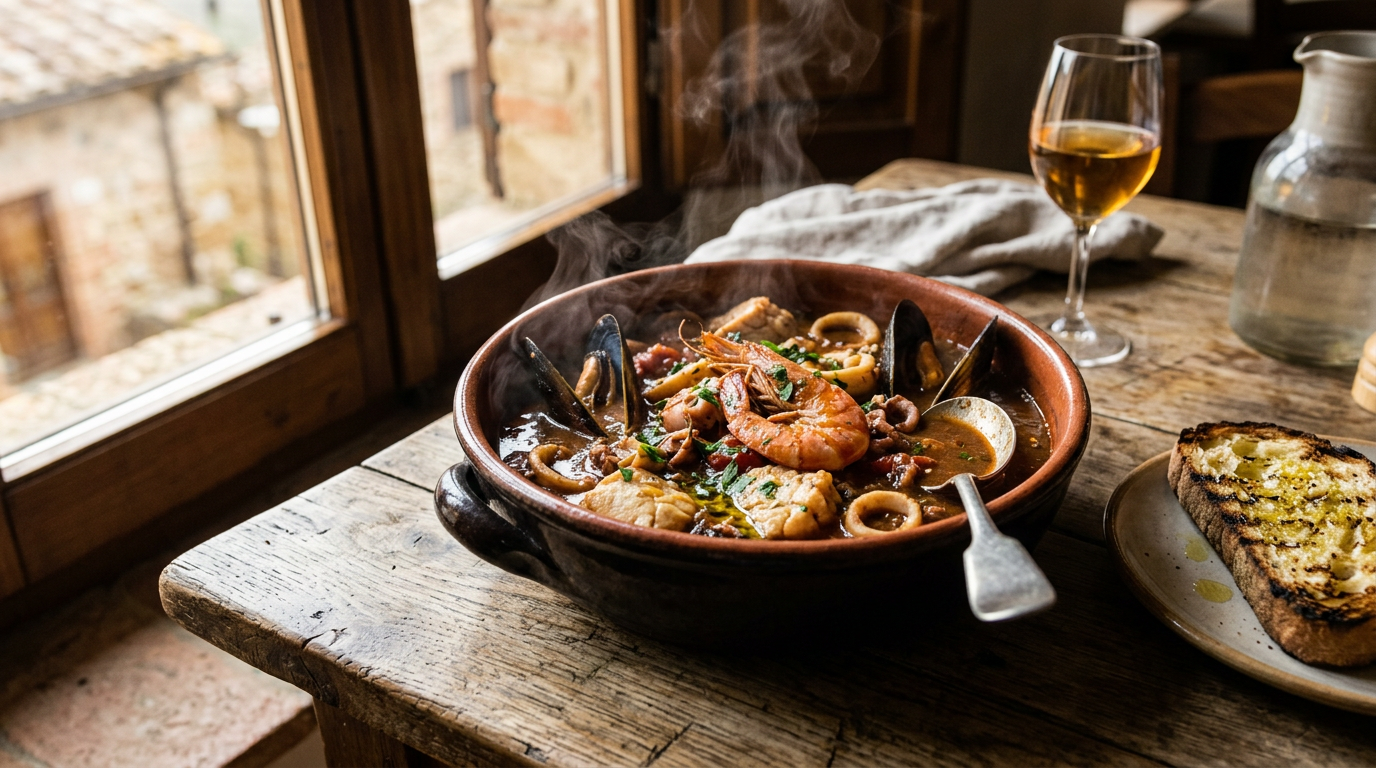
Cacciucco is one of those dishes that resists simple definitions. It is not exactly a soup - the broth is too thick and too flavourful for that. It is not a stew in the conventional sense - the fish pieces are too large and too distinct. It is something of its own: a dense, rich, deeply red preparation of mixed fish in a tomato and wine base, served over thick slices of toasted bread rubbed with garlic.
The name itself is unclear in origin - some linguists trace it to a Turkish word for “small mixed things”, others to an Arabic root meaning “mixture”. What is clear is that cacciucco was born in the port of Livorno, on the Tyrrhenian coast of Tuscany, as a way for fishermen to use the fish that could not be sold at market - too small, too damaged, or simply left over at the end of the day.
This origin story explains almost everything about what makes cacciucco what it is. The variety of fish is not a decoration - it is the point. Each species brings something different to the pot: the scorpionfish and the weever fish give the broth its depth and slight bitterness; the cuttlefish and the octopus add texture; the mussels and clams bring a briny sweetness; the cicala di mare (slipper lobster) adds sweetness and delicacy. Remove any one of them and the result is simply a different dish.
The origins: Livorno, the port and the fishermen
Livorno is a young city by Italian standards - it was founded as a planned trading port by the Medici in the late sixteenth century, designed from the beginning as a place of commerce and tolerance. The city attracted traders, merchants and workers from across the Mediterranean - Jews, Armenians, Greeks, North Africans, Levantines - and this cosmopolitan mix left deep traces in the local culture and cuisine.
The fishermen who worked the Tyrrhenian Sea from Livorno developed a cooking tradition that was direct, practical and intensely flavourful. Cacciucco was the food of the fishing community - made in large pots on the docks or at home by fishermen’s wives, using whatever was available. The wine (the original recipe uses red wine, which surprises many people encountering cacciucco for the first time) was the cheapest available - thick Tuscan red, usually poured directly from the demijohn.
The dish became central to Livornese identity. Today, cacciucco is the most celebrated dish of Livorno, served in every restaurant in the city from the most humble trattoria to the most formal establishment. The Livornese relationship with their cacciucco is almost proprietary - they will tell you, with great seriousness, that any cacciucco made outside of Livorno is at best an approximation.
The seven-C rule: myth or tradition?
The most famous saying about cacciucco states that it must contain at least as many varieties of fish as there are letters “C” in the word “cacciucco” - that is, five. Some versions of the rule say seven.
The rule is charming, and like most charming culinary rules, it is not strictly observed in practice. Ask a Livornese fisherman about the seven-C rule and you will get a smile and a shrug - the important thing, they will tell you, is the freshness of the fish and the quality of the soffritto base, not the exact count of species.
In practice, a well-made cacciucco contains between five and eight varieties of fish, depending on the season and the market. The non-negotiables are the firm-fleshed fish that hold their shape in the broth (scorpionfish, weever, monkfish), the cephalopods (octopus, cuttlefish), and the shellfish (mussels, clams, cicala di mare). Beyond these, the cook exercises judgement based on what arrived that morning from the sea.
The ingredients: which fish you really need
The base of a cacciucco is a soffritto - onion, garlic, celery, and chilli pepper, cooked slowly in olive oil until soft and fragrant. Then comes the tomato (fresh in summer, canned in winter), then the white wine or - in the more traditional version - a small glass of red wine, and then the fish, added in order from the firmest and most robust to the most delicate.
The firm fish go in first: octopus, cuttlefish, weever fish (tracina), scorpionfish (scorfano). These need twenty to thirty minutes of cooking time to release their flavour into the broth. Monkfish and firm-fleshed species go in next. Then, in the last five to ten minutes, the mussels, clams, and the most delicate shellfish.
The bread is not optional - it is structural. Thick slices of Tuscan unsalted bread (pane sciocco), toasted in the oven or on the grill and rubbed with a raw garlic clove, are placed in the bottom of the bowl. The cacciucco is ladled over them. The bread absorbs the broth and becomes part of the dish - soft, flavoured, essential.
Cacciucco inland: how it reaches Poggibonsi fresh every day
Poggibonsi is seventy-five kilometres from Livorno - less than an hour by road through the Tuscan hills. This is close enough for a dedicated kitchen to receive fresh fish every morning from the Livorno fish market, and that is exactly what the team at Ristorante Alcide has done for decades.
The fish arrives in the early morning: whole, fresh, never frozen. It is cleaned and prepared in the kitchen and cooked to order. The cacciucco at Ristorante Alcide is made the way it is made in Livorno - with the same varieties of fish, the same slow-cooked soffritto base, the same toasted bread. The only difference is the setting: instead of the Livornese port, you eat it looking out over the Tuscan hills of the Val d’Elsa.
This is the inland fish tradition of Tuscany - not a compromise or a curiosity, but a genuine cooking tradition born from the proximity of the coast and the quality of the roads and logistics that connect it to the inland towns.
Where to eat cacciucco in Tuscany
In Livorno itself: the place where cacciucco was born, and where it is still made with the most rigorous attention to tradition. The best places are the working-class trattorie near the old port, not the restaurants on the tourist waterfront.
Along the Tuscan coast: Viareggio, Castiglioncello, Follonica - all have strong fishing traditions and restaurants that make cacciucco with locally caught fish.
In the Tuscan inland: a smaller number of restaurants maintain the tradition of fresh Tyrrhenian fish in the interior. Ristorante Alcide in Poggibonsi is among the most established - active since 1849, with direct relationships with Livorno suppliers and a kitchen that treats the cacciucco as its defining dish.
When booking, it is always worth calling ahead to confirm that cacciucco is on the menu that day - in the best kitchens, it depends on what arrived from the sea that morning.
Want to taste it for real?
At Ristorante Alcide you will find it on the table - made the right way, with fresh ingredients and the care of the Ancillotti family since 1849.