Cacciucco
Cacciucco and wine: choosing the right pairing
Red or white with cacciucco? The answer surprises. A guide to pairing cacciucco with Tuscan wines, with specific recommendations.
The pairing dilemma: red or white?
Anyone approaching cacciucco with some knowledge of wine finds themselves faced with a genuine dilemma. The traditional rule says: fish with white wine. Freshness, acidity, floral aromas that do not cover the delicacy of the sea. All reasonable. But cacciucco is not a delicate fish dish.
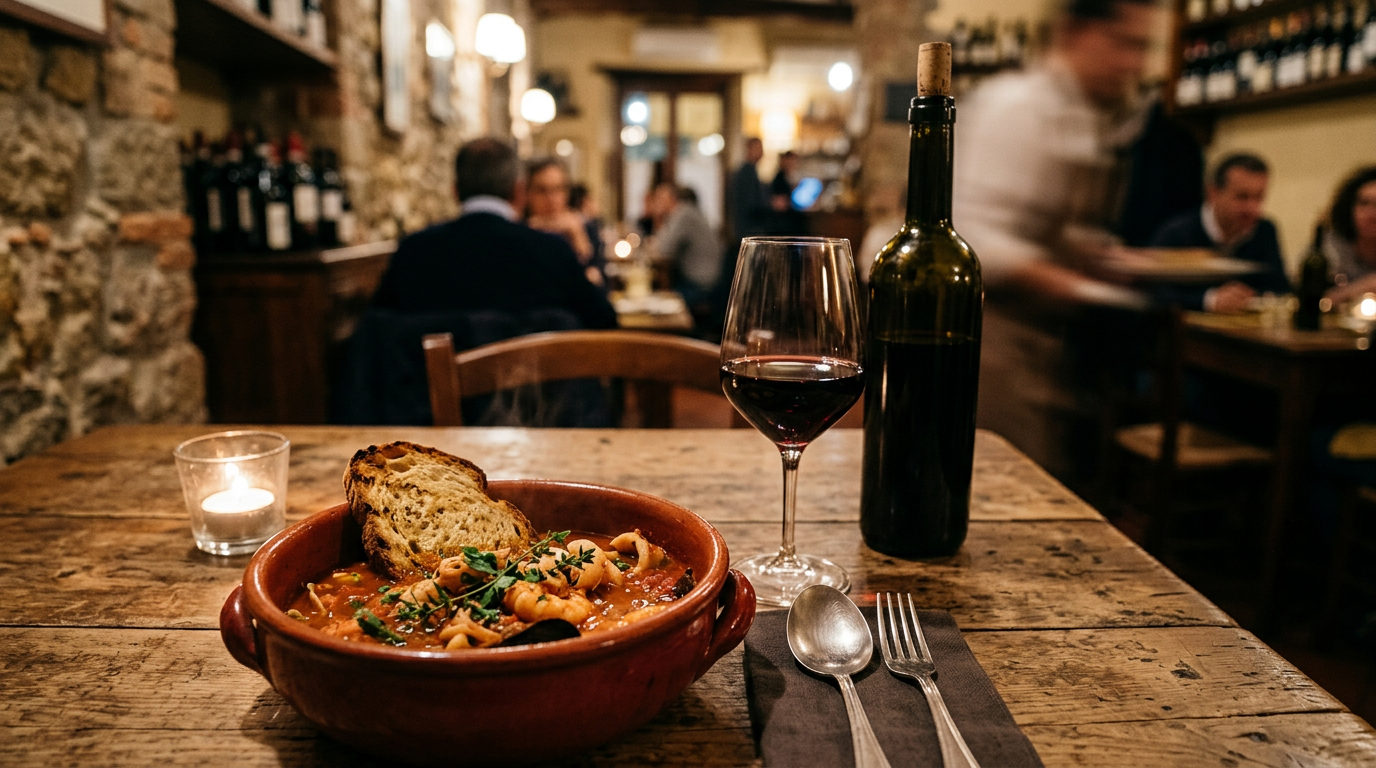
The broth of cacciucco is dark red, dense with concentrated tomato, enriched with red wine during cooking, with octopus and cuttlefish contributing intense and almost earthy flavours. The aromatics - garlic, chilli, sage - create a complexity that brings cacciucco closer to a meat braise than a light fish soup. In this context, a lean and aromatic white wine would be completely lost - it would disappear in comparison like a thin voice in the middle of a heated conversation.
The Livornese tradition has never had doubts: with cacciucco you drink red. Not just any red, not an important Barolo, but a characterful young Tuscan red, with that fruity and tannic quality that balances the acidity of the tomato without overwhelming the marine nuances. The cuisine has already decided - the wine must follow.
Why cacciucco breaks the traditional rules
Food and wine pairing rules are useful as a starting point, not as dogma. The principle of white with fish applies to fish cooked simply - grilled, steamed, as carpaccio. It applies to light fish broths, seafood salads, delicate cuttlefish dishes. But it does not apply to fish cooked with concentrated tomato, red wine, and a soffritto of garlic and chilli for two hours.
Cacciucco is technically a fish dish, but its organoleptic characteristics place it in a category of its own. The intensity of the broth, the tannicity of the red wine already present in the cooking, the density of the texture - all of this demands a wine capable of standing up to the comparison, not of disappearing.
There is also a territorial question that should not be underestimated. Cacciucco is a dish from Livorno, a city that is just a handful of kilometres from the Chianti zone. Tuscan red wines - Chianti, Morellino, Montescudaio rosso - have been the wines of Livornese tables for centuries. The cacciucco-red wine pairing is not a sophisticated choice: it is the tradition that settled naturally, through geographical proximity and complementarity of flavours.
The Tuscan red wines that work with fish
Not all Tuscan reds pair well with cacciucco. The choice requires some thought.
Morellino di Scansano: this is probably the most convincing pairing. Morellino is a Sangiovese from the Maremma - soft, fruity, with less aggressive tannins than Chianti Classico and a saline note often found in wines produced near the sea. Its structure is sufficient to stand up to the cacciucco broth, but it is not so tannic as to cover the fish. Served at 16-17°C, it is almost perfect.
Young Chianti (not Riserva, not Gran Selezione): a simple Chianti Annata, drunk within two or three years of the harvest, has that fruity vivacity and acidity that cleanses the palate well between one spoonful of broth and the next. It is the traditional pairing par excellence - economical, reliable, always readily available in Tuscany.
Montescudaio rosso: less well-known than the previous two, it is a wine from the Cecina area that tastes of the sea and Mediterranean scrubland. Those who know it use it willingly with the most intense fish dishes of the Tuscan tradition.
Bolgheri rosso: more structured, with international influence (Cabernet and Merlot often enter the blend). It stands up to cacciucco, but tends to dominate - it calls for a particularly robust cacciucco.
The white wines that enhance the broth
Having established that red is the traditional choice, there are white wines that work, provided they have structure and character.
Vermentino di Sardegna (and the Tuscan Vermentinos from the Bolgheri and Maremma area): it has a saline minerality and a rich structure that hold up well against the cacciucco broth. Not the classic choice, but an intelligent one for those who prefer white.
Vernaccia di San Gimignano Riserva: not the young and fruity Vernaccia, but the Riserva version aged in wood, with more body and complexity. Vernaccia comes from San Gimignano, twenty kilometres from Poggibonsi - it is a territorial pairing.
Skin-contact white wines (orange wines): the more recent trend sees some sommeliers pairing cacciucco with skin-macerated whites, which have tannins and structure similar to light reds. An unconventional but interesting pairing.
Avoid: thin, aromatic white wines (industrial Pinot Grigio, light Soave, grassy Sauvignon Blanc), dry sparkling wines, Prosecco. These wines disappear in front of the intensity of cacciucco.
The pairing at Ristorante Alcide
At Ristorante Alcide in Poggibonsi, the wine list is built with attention to the territory and the pairings the cuisine requires. With cacciucco, the traditional proposal is a young Morellino di Scansano or a Chianti from the Sienese hills - wines that come from less than fifty kilometres away and that have a natural familiarity with the flavours of the Tuscan sea.
The choice is always guided by the season and the vintage - a particularly fruity year of Morellino pairs differently from a more austere one. The kitchen and the cellar are in dialogue: one of the signs of a restaurant that takes both seriously.
Trust the territory: the final rule
The most honest pairing rule you can give is also the simplest: trust the territory. The wines produced in the same area where a recipe was born have had centuries to adapt to that cuisine. Chianti with bistecca fiorentina, Morellino with cacciucco, Vernaccia with fish from the Tyrrhenian Sea - these pairings were not invented by a sommelier from a textbook. They are the result of generations of cooks and winemakers sitting at the same table.
When in doubt, choose the wine from the region closest to the dish. And trust it.
Want to taste it for real?
At Ristorante Alcide you will find it on the table - made the right way, with fresh ingredients and the care of the Ancillotti family since 1849.