Steak & Meat
Chianina: the Tuscan beef breed that made history
The Chianina is Italy's oldest cattle breed and the foundation of bistecca fiorentina. History, characteristics and why the meat is unmatchable.
The Chianina: Italy’s oldest breed
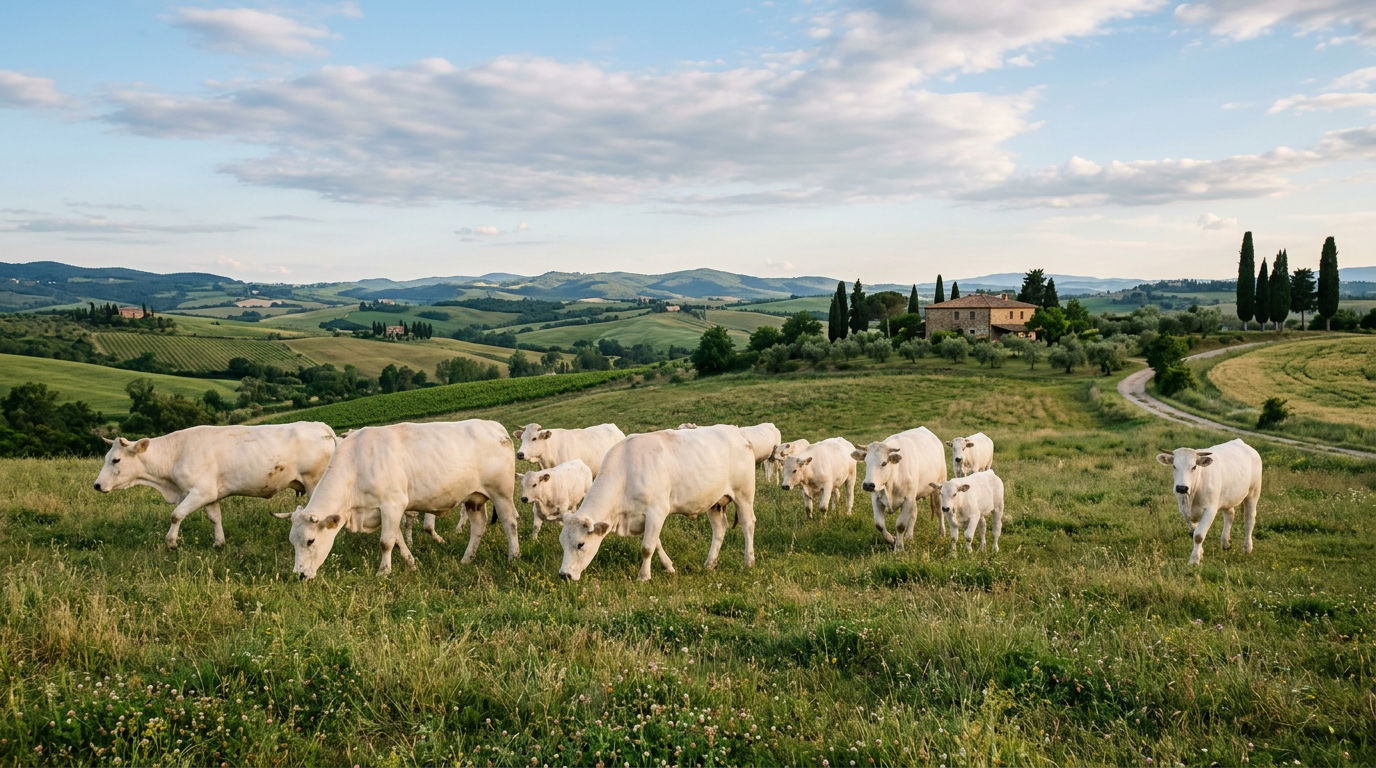
When discussing Italian cattle breeds, the Chianina occupies a unique position. It is not only the most widespread breed in eastern Tuscany - it is probably the oldest cattle breed still in production in the world. Its origins trace back to the cattle raised by the Romans in the Chiana plain, the fertile valley that extends between Arezzo and Chiusi, and are documented in Etruscan frescoes, Roman bas-reliefs and writings by Columella and Pliny the Elder, who describe the “white oxen” of the Val di Chiana as the best in Italy for work and for meat.
The porcelain white colour - which becomes a lighter grey in adult females - is the immediate distinguishing mark of the breed. The Chianina is an imposing bovine: breeding bulls reach 1,700-1,800 kg, cows 900-1,100 kg. With these dimensions it is the largest cattle breed in the world - a record that contributes to its international fame but is not its primary gastronomic value.
For centuries the Chianina was raised primarily as a working animal - its strength and endurance made it ideal for work in the fields of agricultural Tuscany. Only in the twentieth century, and in particular with the mechanisation of agriculture that eliminated the need for animal labour, was the Chianina selected exclusively for meat production. The transition required decades of animal breeding work to optimise the characteristics of the meat without losing the constitutional qualities of the breed.
From the Val di Chiana to the table: the journey
The journey from the birth of a Chianina calf to a bistecca fiorentina on a restaurant table requires years of care and a quality chain that, if broken at any single point, compromises the final result.
Chianina calves are born in winter - from November to March - and raised on their mothers’ milk for the first months. They then follow the cows to pasture on the hills of the Val di Chiana, the Val d’Orcia and surrounding areas, feeding on pasture grass and local hay. Grass-feeding is fundamental - Chianina raised intensively on maize and grain produces different meat, with more fat and less character.
Cattle destined for meat are slaughtered between 15 and 24 months of age, with a live weight of around 600-700 kg. After slaughter, the meat is dry-aged - matured in temperature and humidity-controlled cold rooms - for a period ranging from 30 to 60 days. Dry ageing is the step that transforms already good meat into something different: the natural enzymes in the meat work on the muscle fibres, tenderising them and developing the flavours.
Characteristics of Chianina meat
Chianina meat has a very precise organoleptic profile, recognisable to those who know the raw ingredient.
The colour: vivid red, almost brilliant, with little creamy-white covering fat. It does not have the abundant marbling of northern breeds (Angus, Wagyu) - Chianina is a lean meat, with fat concentrated mainly in the seams between muscle groups rather than infiltrated within the fibre.
The smell: clean, with herbal and almost sweet notes reminiscent of hay. No gamey notes or excessive intensity.
The raw texture: firm, compact, with visible and well-defined muscle fibres. Well-aged Chianina yields differently under pressure from fresh meat - it is soft but not flaccid.
The cooked flavour: what surprises most those who expect the fatty richness of marbled meat is the cleanliness of the flavour. Rare-cooked Chianina has an intense bovine taste, almost metallic in its purity, with a sweetness at the end that comes from the sugars of the pasture. It is not the rich flavour of Wagyu - it is the true flavour of well-raised beef.
Chianina vs other breeds: the organoleptic differences
The comparison with the most internationally known cattle breeds highlights how specific and non-generalisable a product the Chianina is.
Chianina vs Angus: Aberdeen Angus is the most widespread beef breed in the world, originally from Scotland. It produces highly marbled meat, with abundant infiltrated fat that gives a rich, buttery flavour. Angus steak is tender almost regardless of the cooking. Chianina has less fat, is leaner, with a cleaner flavour that requires correct cooking to express itself best.
Chianina vs Wagyu: Japanese Wagyu represents the precise opposite of Chianina. Infiltrated fat can exceed 40% of the weight of the meat, creating an almost melting texture. It is a completely different taste experience - not better in absolute terms, but different. Those seeking meat in the most direct sense - fibre, flavour, minerality - find more satisfaction in Chianina.
Chianina vs Maremmana: another Tuscan breed, the Maremmana is more rustic and less selected for meat. It has a wilder and more intense flavour than Chianina, with a coarser fibre. It is good but different - better suited to braises and stews than to the grilled bistecca.
How to recognise certified Chianina meat
On the market you find meats presented as “Chianina” that are not always genuinely so. How to distinguish?
The IGP mark “Vitellone Bianco dell’Appennino Centrale” guarantees that the meat comes from cattle of the Chianina, Marchigiana or Romagnola breeds raised in the Central Apennine area. It is not only Chianina, but covers the most prized Italian white breeds.
Some butchers and restaurants that work with certified breeds display the certificate of provenance or can provide information about the farm of origin. It is a sign of transparency worth looking for.
The colour of the meat is a clue: genuine Chianina is brilliant red with creamy-white fat. A reddish-purple meat with yellowish fat indicates an older animal or a different breed.
Chianina in Tuscany today: producers and protection
The Chianina is one of the cattle breeds protected by the Italian Ministry of Agriculture as a native Italian breed at risk of extinction - although “risk” may be an excessive term for a breed that maintains reasonable numbers in its area of origin. The number of animals did decrease significantly in the post-war period, when agricultural industrialisation penalised native breeds in favour of more quantitatively productive ones.
Today Chianina is raised by a network of producers from the Val di Chiana and surrounding areas who have chosen to prioritise quality over quantity. The protection association, in collaboration with local institutions, works to promote the breed and protect its mark. Tuscan restaurants that propose it seriously indicate the provenance on the menu - it is a value worth communicating.
Want to taste it for real?
At Ristorante Alcide you will find it on the table - made the right way, with fresh ingredients and the care of the Ancillotti family since 1849.