Tuscan Wines
Chianti wine guide: everything a visitor needs to know
Everything you need to know about Chianti wine before visiting Tuscany. Chianti vs Chianti Classico, the Gallo Nero, best producers and food pairings.
Chianti vs Chianti Classico: they are not the same
The most common misunderstanding among visitors buying Chianti wine in Tuscany is treating “Chianti” and “Chianti Classico” as the same denomination. They are not.
Chianti DOC is a large and geographically diffuse denomination covering seven sub-zones across most of Tuscany, including Chianti Colli Senesi (around Siena), Chianti Colli Fiorentini (around Florence), Chianti Rufina (northeast of Florence), and others. The minimum Sangiovese content is 70%, and the quality level varies significantly between producers and sub-zones.
Chianti Classico DOCG is a distinct, geographically delimited denomination covering the historic zone between Florence and Siena - specifically the municipalities of Greve in Chianti, Panzano, Radda, Gaiole, Castelnuovo Berardenga, and parts of Barberino Tavarnelle and San Casciano. The minimum Sangiovese content is 80%, the production rules are stricter, and the quality level is generally higher and more consistent.
The two denominations are completely separate - a bottle labelled “Chianti Classico” is not a superior version of “Chianti”. It is a wine from a different, more restricted geographical zone with different production rules. The fact that they share part of their name is a historical accident that causes confusion to this day.
When choosing between the two, the practical advice for visitors is: look for the Gallo Nero (Black Rooster) on the neck of the bottle - it guarantees you are buying a Chianti Classico DOCG, not one of the broader Chianti DOC denominations.
The Gallo Nero: what the black rooster means
The black rooster on a green background is the symbol of the Chianti Classico Consortium - the association of producers that protects and promotes the denomination. It appears on the neck of every bottle of Chianti Classico DOCG certified by the consortium.
The legend behind the symbol is medieval: during a long territorial dispute between Florence and Siena over the border between their territories, the two cities agreed to resolve the matter with a horse race. Each city would send a rider at dawn, and the border would be set where the two riders met. Florence chose a black rooster as its symbol and, following the old trick, kept the rooster hungry before the race so it would crow earlier in the darkness before true dawn. The Florentine rider set off before the Sienese, rode further into Sienese territory, and established a border that favoured Florence significantly.
Whether or not the legend is true, the black rooster has been associated with Chianti and with Florence since the thirteenth century, and today it remains one of the most recognizable symbols in Italian wine.
The Chianti Classico zone: a map in words
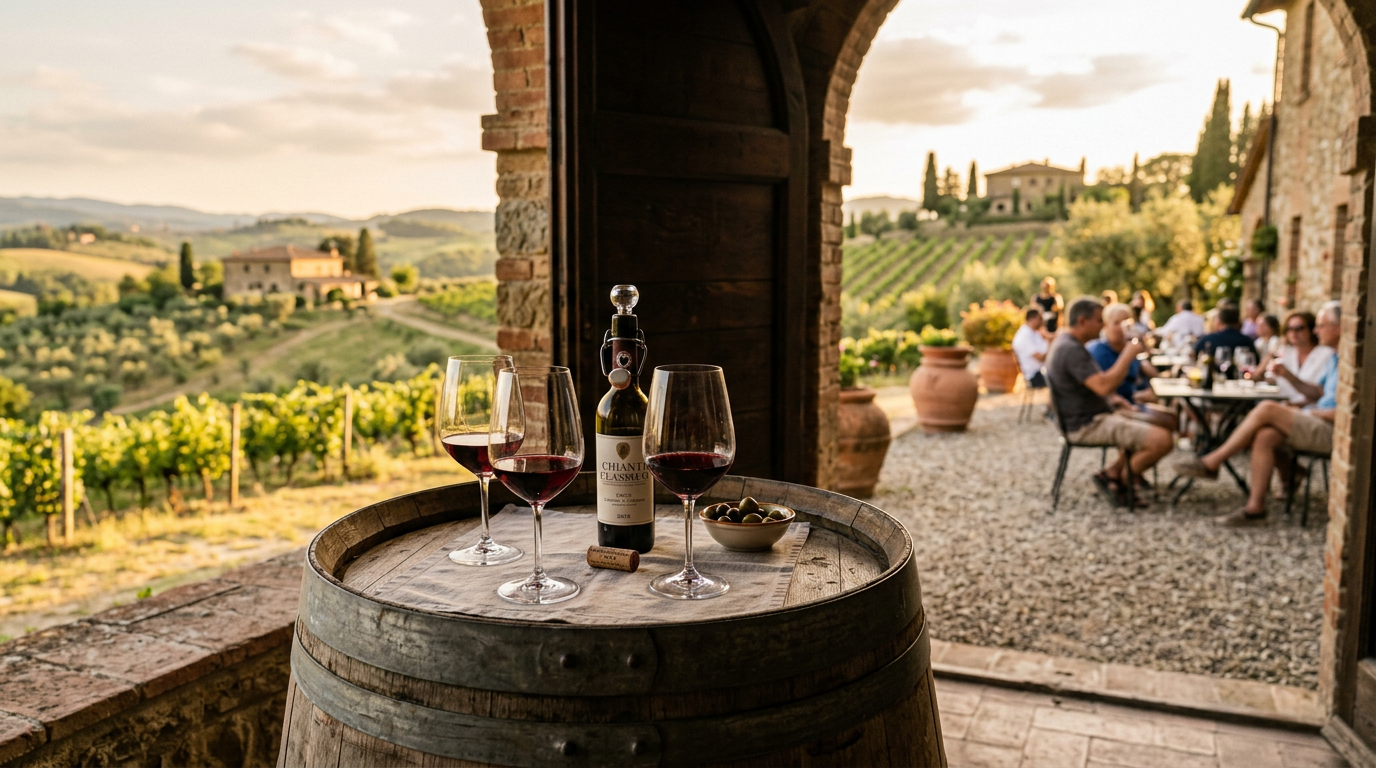
The Chianti Classico zone is a stretch of hills between Florence and Siena, roughly forty kilometres from north to south and twenty from east to west. The landscape is the quintessential Tuscan postcard: vineyard slopes alternating with olive groves and cypress avenues, medieval stone towers, hilltop villages, and the occasional glimpse of distant blue hills.
The northern part of the zone, around Greve in Chianti and Panzano, produces wines that tend to be elegant and structured, with bright red fruit and fine tannins. The central zone around Radda and Gaiole produces some of the most complex and age-worthy expressions. The southern zone around Castelnuovo Berardenga, closest to Siena, tends to produce fuller-bodied, rounder wines.
The famous SR222 (the Chiantigiana, or “Chianti road”) runs through the heart of the zone from Florence to Siena - a drive on this road, stopping at estate wineries and the small towns along the way, is one of the most rewarding experiences in Tuscany for anyone interested in wine and landscape.
Reading the label: Annata, Riserva and Gran Selezione
Chianti Classico DOCG comes in three quality tiers, each with different ageing requirements and each expressing a different level of ambition from the producer.
Chianti Classico Annata (annual vintage): the base level of the denomination, released after a minimum of twelve months of ageing (six in oak and six in bottle). These are the most approachable and affordable wines of the denomination - ready to drink young, with fresh red fruit character, medium structure, and the characteristic Chianti Classico bitterness on the finish.
Chianti Classico Riserva: released after minimum twenty-four months of ageing, including at least three months in bottle. These wines are more structured and complex than the Annata, with greater ageing potential. The best Riserva can improve for ten to fifteen years in the bottle.
Chianti Classico Gran Selezione: the highest tier of the denomination, introduced in 2014. Released after a minimum of thirty months of ageing, including at least three months in bottle. Must come from a single vineyard or a selection of estate’s best grapes. These are the most expensive and most age-worthy wines of the zone.
Best food pairings: from bistecca to cacciucco
Chianti Classico is a food wine - it was designed, through centuries of cultivation and winemaking, to go with the food of Tuscany. The Sangiovese grape has high natural acidity and firm tannins, which make it an excellent partner for the rich, flavourful cooking of the region.
With bistecca fiorentina: the classic pairing. The acidity of the Chianti cuts through the fat of the meat, the tannins bond with the proteins, and the regional match - Chianina beef from the same hills where the grapes grow - creates a coherence that is hard to argue with. A Riserva or a Gran Selezione with a minimum of five years of age is ideal.
With wild boar and game ragù: the savoury, gamey intensity of a wild boar pappardelle is one of the best partners for a young Chianti Classico Annata - the bright acidity lifts the richness of the meat and the fresh fruit of the wine complements the herbs in the sauce.
With cacciucco: this pairing surprises visitors who expect a white wine with fish. The density and richness of cacciucco - the long-cooked tomato base, the variety of fish, the wine already in the recipe - demands a red with body and presence. A young Chianti Classico Annata, slightly cool (around 16°C), works well. At Ristorante Alcide in Poggibonsi, this is the pairing that the kitchen recommends.
With pecorino and aged cheese: the tannins of a mature Riserva with a well-aged Pecorino Toscano is a combination of contrasts - the astringency of the wine against the fat and salt of the cheese - that works because both elements are strong enough to hold their own.
How to buy Chianti without being fooled
The most important rule: always look for the Gallo Nero consortium seal on the neck of the bottle if you want Chianti Classico. Without it, you may be buying a Chianti DOC from a sub-zone that has nothing to do with the historic Classico zone.
The second rule: price is a rough guide. A Chianti Classico Annata from a quality producer sells for around fifteen to twenty-five euros in a wine shop; a Riserva for twenty-five to fifty euros; a Gran Selezione for fifty euros and up. Bottles sold for less than ten euros labelled as Chianti Classico are either entry-level products from large cooperatives or, more rarely, genuine bargains. The very cheap bottles of “Chianti” in straw-covered flasks (fiaschi) are a tourist product with no relationship to the serious wines of the denomination.
The best way to buy Chianti is directly from a producer - either at the cantina in the Classico zone or through a reputable wine shop that works directly with estates. Many wineries in Greve in Chianti, Panzano and Radda offer tastings and cellar-door sales, which allows you to taste before you buy and to understand the producer’s style.
Want to taste it for real?
At Ristorante Alcide you will find it on the table - made the right way, with fresh ingredients and the care of the Ancillotti family since 1849.