Steak & Meat
Cinta Senese: the Tuscan pig you cannot find anywhere else
The Cinta Senese is Tuscany's native pig breed, nearly lost and then recovered. History, characteristics and how it is used in cooking.
The Cinta Senese: Lorenzetti’s pig
If you want to find the oldest representation of the Cinta Senese, do not go to a farm - go to the Palazzo Pubblico in Siena. In Ambrogio Lorenzetti’s famous fresco of the Effects of Good Government (1338-1339), among the scenes of rural life in medieval Tuscany, you can clearly recognise pigs with a characteristic light band across their backs contrasting with the dark fur of the rest of the body. That band - the cinta or “belt” - is the distinguishing mark of the breed that bears the name of the city.
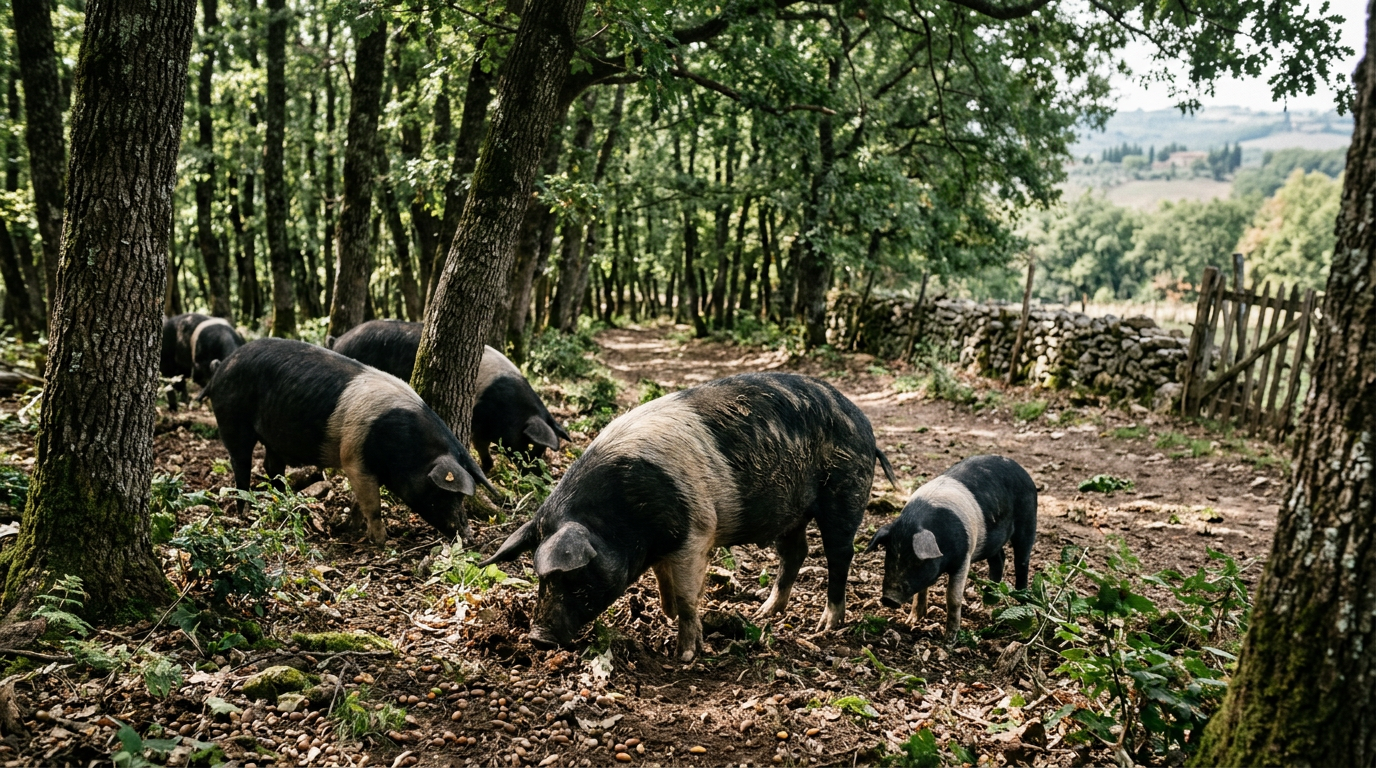
The Cinta Senese is one of Italy’s oldest native pig breeds, with a documented history of over seven hundred years in the Sienese countryside. Its appearance is immediately recognisable: dark grey or black fur, with a whitish band crossing the shoulders and front legs - like a lighter belt tightened around the body. The ears are large and carried forward. The snout is elongated and adapted to rooting for roots and acorns in the underbrush.
For centuries this pig has grazed semi-free in the oak forests and chestnut groves of the Sienese hills, feeding on acorns, beechnuts, tubers, roots and wild fruits. This forest diet is the primary reason for the character of its meat - a wild and complex flavour not found in industrial pigs raised in stalls.
Nearly extinct: the story of the recovery
By the mid-twentieth century, the Cinta Senese risked permanent disappearance. The industrialisation of pig farming had brought intensive breeding of fast-growing foreign breeds - the Large White, the Landrace - that produced meat in much greater quantities and in much shorter times. The Cinta Senese grew slowly, needed space, did not adapt to intensive stalling. In economic terms it was not competitive.
From the 1950s to the 1970s the number of animals fell dramatically - it reached the point where some researchers in the animal science world counted fewer than three hundred animals remaining in all of Tuscany. The breed was one step from extinction.
Recovery began in the 1980s, led by visionary breeders and scientific institutions such as the Faculty of Agriculture of the University of Florence, which contributed to the genetic cataloguing of the last remaining specimens and to the definition of a conservation and breeding programme. The gastronomic valorisation - the recognition of the quality of its salumi and meat by chefs and aware consumers - gave an economic impulse to breeding that made the conservation project sustainable.
Today the Cinta Senese has obtained the DOP (Protected Designation of Origin) for its salumi, and the number of animals has stabilised and grows every year.
Characteristics of the meat: why it is different
Cinta Senese meat is different from common pork in a clear and immediate way - you do not need to be an expert to perceive it.
The fat: the Cinta Senese has a significantly higher percentage of fat than commercial pigs. This fat is distributed differently - subcutaneous but also infiltrated into the muscle fibres - and has a particular chemical composition. It is rich in unsaturated fatty acids (similar to olive oil in its composition), which makes it softer at room temperature and gives it a lower melting point. This means it melts in the mouth at body temperature - that is the melt-in-the-mouth sensation that characterises a good lardo or a good Cinta porchetta.
The flavour: intense, complex, with wild notes that recall the forest. It is not the neutral flavour of industrial pork - it has a character of its own, almost like game, that comes from the diet of acorns and roots. There is an underlying sweetness, balanced by that herbal and woody note that comes from living outdoors.
The colour: darker than common pork - almost red-purple in the leg and the prosciutto. It is the sign of an animal that has lived in movement, with well-oxygenated muscles.
Cinta Senese DOP salumi
The salumi of Cinta Senese are perhaps its highest expression - the way the Tuscan norcino tradition has known best how to valorise this raw ingredient.
Cinta Senese prosciutto: aged for at least twelve months, with a more pronounced sapidity and a more complex aroma than conventional Tuscan prosciutto. The fat is abundant but not intrusive - it literally melts in the mouth.
Finocchiona di Cinta: the most typical Tuscan salame, made with minced Cinta meat and flavoured with wild fennel seeds. The Cinta version has a softness and a different fat that make it superior to the industrial version.
Cinta lardo: the dorsal fat layer, aged with seasoned salt. It does not reach the fame of Lardo di Colonnata (which is a specific technique in marble troughs) but has a character of its own - darker, more flavourful, with the wild note of the breed.
Sausage and salame: fresh or aged, these are among the most easily found products in farm shops and butchers in the Sienese area.
How to cook Cinta Senese
In the kitchen, Cinta Senese requires a different approach from commercial pork, especially for its different fat content.
Roast: the shoulder and the leg are well suited to slow roasting in the oven, where the fat melts gradually and bastes the meat during cooking. Adding rosemary, garlic and black pepper enhances the wild flavour of the meat.
Cinta porchetta: a tradition of Tuscan festivals, Cinta porchetta is a level above the industrial version. The abundant fat of the breed creates that crispy crust and that soft, moist interior that is the sign of a well-made porchetta.
Ribs and guanciale: Cinta ribs grilled or roasted with Tuscan aromatics are a simple and satisfying dish. The guanciale, briefly aged, is one of the most used ingredients in Sienese cooking to enrich soups and bean dishes.
Where to find it in Tuscany
Cinta Senese is found at farmers’ markets in the Sienese area, in the farm shops of breeders (many of whom have their own direct sales point), and in selected butchers and food shops in Tuscany. The DOP mark guarantees provenance and farming method - looking for it is the simplest way to be certain of buying the authentic product.
Tuscan restaurants that work with controlled supply chains - like Ristorante Alcide in Poggibonsi, which selects its land products with the same care with which it chooses Tyrrhenian fish - use Cinta Senese in territorial preparations that enhance the wild character of the meat without covering it.
Want to taste it for real?
At Ristorante Alcide you will find it on the table - made the right way, with fresh ingredients and the care of the Ancillotti family since 1849.