Tuscan Pasta
Tuscan fresh pasta: the 5 shapes every enthusiast should know
Pici, pappardelle, tagliolini, maltagliati, testaroli. The 5 most important forms of Tuscan fresh pasta, with history and traditional sauces.
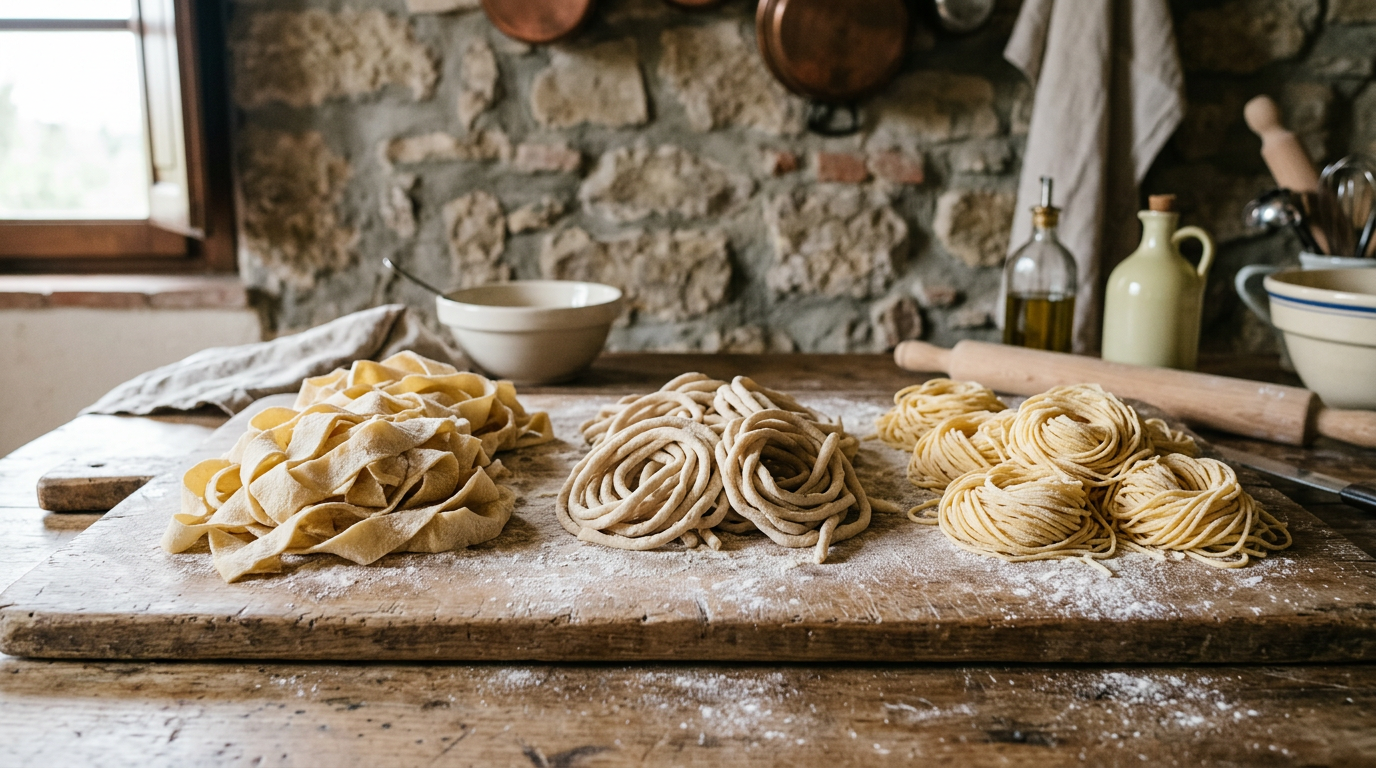
Fresh pasta in Tuscany: its own tradition
Tuscany is not the first region that comes to mind when thinking of fresh egg pasta - that honour belongs to Emilia-Romagna, with its sfogline, tagliatelle and tortellini. But Tuscany has its own fresh pasta tradition, with distinct characteristics and shapes not found in any other Italian region.
The fundamental difference is in the philosophy. While Emilian pasta aims for fineness, the near-transparent thinness of the sheet, the rich and velvety egg pasta, Tuscan pasta is more robust, more rustic, often without eggs or with very few, with a texture that prioritises chewiness over elegance. It is a pasta that reflects the Tuscan character - direct, solid, without frills.
The five shapes below are those that best define the identity of Tuscan fresh pasta: two without eggs (pici and testaroli) and three egg-based (pappardelle, tagliolini, maltagliati). Each has its own history, its own territory and its favourite sauces.
Pici: the eggless pasta
Pici are thick hand-rolled spaghetti made with flour and water. They are the oldest and most typical shape of southern Tuscany - the quintessential peasant pasta, born from necessity and refined by the practice of generations.
Their texture is unique: more tenacious and more present in the mouth than any egg pasta, with a wheat note that persists to the end. They hold up to robust sauces - wild boar ragù, aglione sauce, toasted breadcrumbs - with a solidity that no thin shape could sustain.
Pici are found throughout southern Tuscany, with epicentre in the Siena, Montalcino and Val d’Orcia area. In the Val d’Elsa - around Poggibonsi and San Gimignano - they are found in traditional tratttorie as the symbolic dish of local cooking.
Pappardelle: the hunting pasta
Pappardelle are the quintessential Tuscan egg pasta - wide, flat, irregularly cut into broad strips of two to three centimetres. The name comes from the Tuscan pappare - to eat with relish, to devour - and reflects the indulgent character of this shape.
The Tuscan pappardelle sheet is thicker than the Emilian one - you feel it under the teeth, it has its own presence. They are traditionally dressed with game meat sauces: hare, wild boar, pheasant, pigeon. The width of the pasta is functional - it holds the dense ragù on its broad surface, making every mouthful at once pasta and sauce, without one prevailing over the other.
Pappardelle alla lepre (with hare ragù) is the symbolic autumn Tuscan dish. The hare marinated in Chianti and slow-cooked with aromatics and tomato produces a dense and intense ragù that finds its natural partner in pappardelle.
Tagliolini: elegant and versatile
Tagliolini are the thinnest variant of Tuscan egg pasta sheet - thinner than Emilian tagliatelle, almost capellini, with a fineness that makes them suited to delicate sauces. In Tuscany they are traditionally used with seafood sauces - clams, mussels, prawns - where their thinness does not overwhelm the delicate flavours of the shellfish.
At Ristorante Alcide, tagliolini with clams are one of the most requested seafood first courses. The egg pasta sheet, rolled thin, pairs with the saline flavour of the clams and the aroma of garlic and parsley in a way that very few other shapes can achieve.
Tagliolini are made with egg pasta sheet using more egg white than tagliatelle sheet, giving a finer and more elastic pasta. Cooking is very quick - one to two minutes in boiling water - and the tossing must be immediate to avoid losing the heat.
Maltagliati: the shape of imperfection
Maltagliati are egg pasta cut irregularly - diamonds or squares of variable size, with non-uniform edges. The name says it all: badly cut, intentionally. They were born as a recovery of leftover pasta sheet scraps from making other shapes - the edges of pappardelle, tagliatelle trimmings - but have become a shape of their own with a precise identity.
The irregular shape is not a technical defect - it is an aesthetic and functional choice. Maltagliati collect sauce differently depending on the angle of cut: the thinner edges cook faster and become almost transparent, while the thicker parts remain al dente. In a single dish there are different textures - and this variation is part of the pleasure.
Traditionally dressed with simple sauces - beans and legumes (maltagliati e fagioli is a Tuscan classic), porcini mushrooms in autumn, simple fresh tomato in summer.
Testaroli from Lunigiana: the special case
Testaroli are the most anomalous pasta of the Tuscan tradition - so anomalous as to be almost a category unto itself. Originally from Lunigiana (the border zone between Tuscany and Liguria, in the upper Massa-Carrara area), testaroli are prepared with a liquid batter of flour, water and salt that is poured onto a testo - a cast iron pan with a lid, heated over a direct flame - and cooked like a thick crepe.
The result is a circular pasta, about half a centimetre thick, which is then cut into diamonds and briefly blanched in boiling water before being dressed. The texture is completely different from any other fresh pasta - chewy, dense, with an almost fermented wheat flavour that is the sign of the slow cooling after cooking on the testo.
The traditional sauce is simple: basil pesto, or olive oil and Parmesan. The special quality of testaroli is that they absorb the sauce differently from any extruded pasta - the pesto enters their pores and distributes itself almost capillary.
Which shape to choose and why
The choice of pasta shape is not arbitrary - every sauce has its natural partner, and the Tuscan tradition has refined these pairings over centuries.
Robust and meaty sauce (wild boar ragù, hare, meat ragù): pappardelle or thick pici. Width and thickness stand up to the density of the sauce.
Delicate seafood sauce (clams, prawns, white fish): tagliolini. Their thinness does not overwhelm the marine flavours.
Simple and rustic sauce (breadcrumbs, aglione, simple tomato): pici. The robust pasta brings the minimal ingredient to the fore.
Vegetable or legume sauce (beans, mushrooms, fresh tomato): maltagliati. The irregular shape lends itself to sauces with irregular pieces.
Fresh and aromatic sauce (pesto, oil and cheese): testaroli. Their porosity collects the sauce in a unique way.
Want to taste it for real?
At Ristorante Alcide you will find it on the table - made the right way, with fresh ingredients and the care of the Ancillotti family since 1849.