Peasant Cuisine
Panzanella toscana: the summer recipe that divides Italy
Authentic Tuscan panzanella: stale unsalted bread, ripe tomatoes, basil and olive oil. The summer recipe that divides Italy - with or without cucumber?
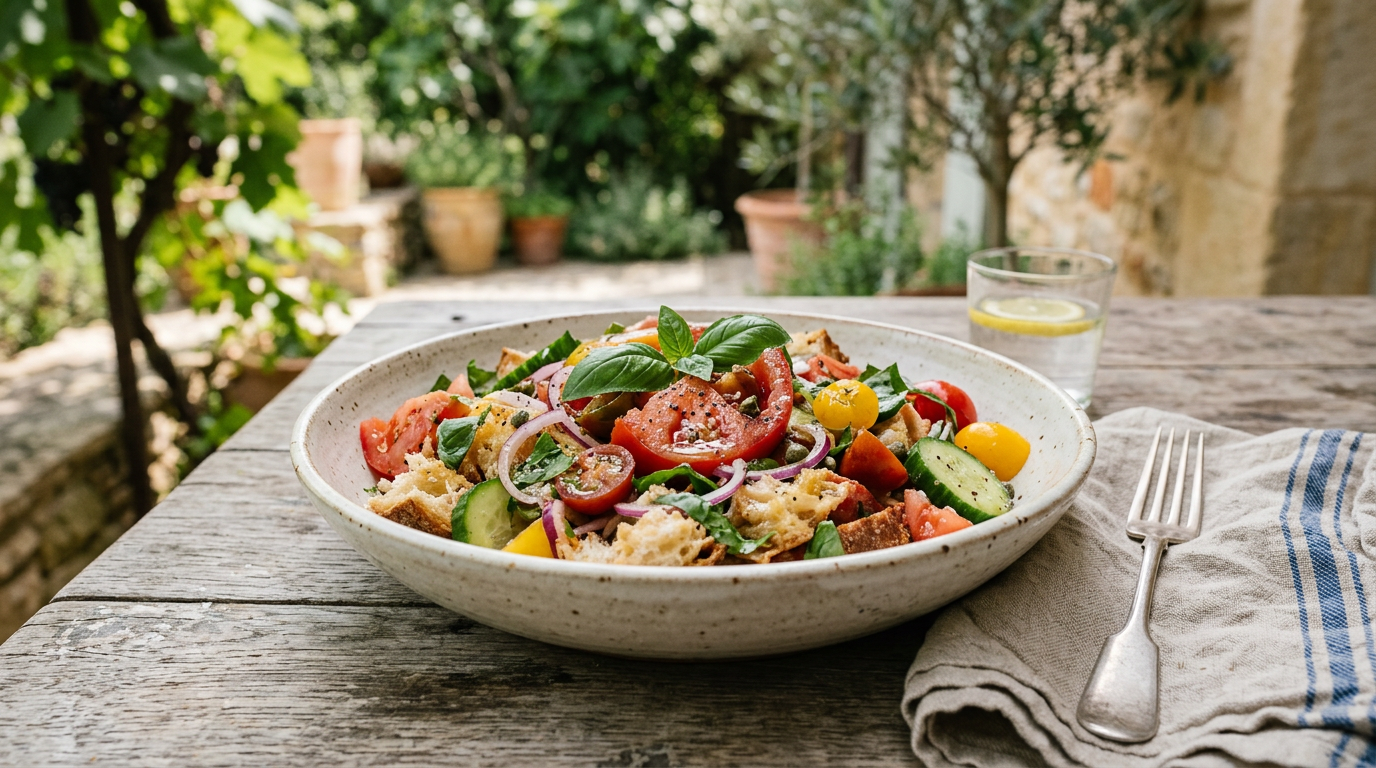
Panzanella: summer in a dish
There are dishes that belong to a season so exclusively that outside that season they make no sense. Panzanella is one of them. You do not make it in winter, not with supermarket tomatoes from February, not with fresh bread. It is an August dish - that Tuscan August when the cuore di bue tomatoes or the costoluti di Pachino reach the perfect point of ripeness, the basil leaves are large and fragrant, and the two-day-old stale bread is at exactly the right degree of hardness to soak and squeeze.
Panzanella was born as a recovery dish - the stale Tuscan unsalted bread was not thrown away, it was soaked, dressed with what was in the garden. In summer there were tomatoes, basil, onion, cucumber. In winter there was nothing fresh and panzanella did not exist. This absolute dependence on seasonality is one of the reasons the dish has maintained its identity over the centuries - it cannot be standardised, cannot be made at any time of year, cannot be abbreviated without losing something essential.
The name has uncertain etymology - some connect it to pane (bread) and zanella (the terracotta bowl it was served in), others to an obscure dialectal Tuscan term. The first written mention is from the sixteenth century, in a sonnet by Bronzino that described a “panzanella” with onion - already then the dish was recognisable enough to appear in literature.
The stale unsalted bread: why it cannot be substituted
The bread is the structural heart of panzanella. Not just any bread - the Tuscan unsalted pane sciocco, stale for at least two days, preferably three.
The neutrality of the unsalted bread is fundamental: it does not bring competing flavours, does not interfere with the tomato, basil or oil. It becomes a neutral support that absorbs the tomato juice, the vinegar, the oil, transforming itself into something different from any other ingredient in the dish.
The staleness is equally important. Fresh bread would disintegrate in the soaking, becoming a soft mush without structure. Stale bread has a dense crumb that softens slowly - after soaking in water and squeezing, it maintains an almost meaty consistency that holds the bite without dissolving. It is that intermediate consistency - neither crispy nor mushy - that gives panzanella its characteristic texture.
What happens if you use the wrong bread: salted bread produces a panzanella that is too sapid and unbalanced. Fresh bread produces a mush. Industrial bread with preservatives stays hard and does not absorb the dressing well. None of the alternatives really work.
The tomatoes: the ingredient that makes the difference
In summer, with the right tomatoes, panzanella is almost impossible to make badly. With the wrong tomatoes, it is almost impossible to make well.
The tomatoes for panzanella must be ripe - not to the point of going soft, but at maximum ripeness. The flesh must be red to the centre, without that white and tasteless part that characterises tomatoes picked early. The juice must be abundant - that red, flavourful liquid that flows when you cut a ripe tomato is part of the dressing.
The best varieties: cuore di bue (large, meaty, with little water and much flesh), costoluto fiorentino (similar but more irregular), ramati romani (smaller, more acidic, very flavourful). Cherry tomatoes and garden tomatoes add sweetness. Industrial round and uniform supermarket tomatoes do not have the necessary flavour.
The tomatoes are cut into irregular pieces - not precise cubes - and left with a pinch of salt for ten minutes. This process draws out the juice that will then dress the entire dish. The juice is not discarded - it is the most precious dressing.
The cucumber dispute: the definitive answer
There has been for decades, probably for centuries, a passionate dispute about the presence of cucumber in Tuscan panzanella. The cucumber supporters defend it as a long-standing traditional ingredient; opponents consider it a foreign intrusion.
The historical answer is that cucumber was present in traditional panzanella in some areas of Tuscany - in particular the Maremma and coastal areas - while absent or rare in the Florentine and Sienese tradition. There is no “official” version of panzanella, so there is no definitive answer on authenticity.
The gastronomic answer is simpler: cucumber adds freshness, wateriness and a herbal note that balances the acidity of the tomato and the intensity of the oil. If the cucumber is good (not bitter, not watery) and used in measured quantity, the panzanella is better. If the cucumber is of mediocre quality, it is better left out.
The real dispute is more often between the purists who want only bread, tomato, onion, basil and oil (the minimalist version) and those who also add celery, anchovies, peppers, olives. These last additions are already another story.
The authentic recipe step by step
For four people: 300 grams of stale Tuscan unsalted bread, 500 grams of ripe tomatoes, half a red Tropea onion (or fresh white onion), a few basil leaves, red wine vinegar, Tuscan extra virgin olive oil, salt.
The bread: cut into slices one centimetre thick and immerse in cold water for 10-15 minutes. Squeeze well with the hands to eliminate excess water, then break into irregular pieces in a large bowl.
The dressing: cut the tomatoes into pieces and leave with the salt for ten minutes. Slice the onion very finely and leave to soften in water and vinegar for twenty minutes (to reduce the aggressive taste). Drain the onion and add to the tomatoes with their juice.
Assembly: combine the crumbled bread, the tomatoes with their juice, the onion, the basil leaves broken by hand (not cut - a knife oxidises the basil). Dress with abundant extra virgin olive oil, a few drops of vinegar, salt and black pepper.
Resting: essential. Panzanella must rest in the refrigerator for at least half an hour - better an hour - before being served. In this time the bread absorbs the dressing and the dish comes together. Taste before serving and adjust vinegar and oil.
Panzanella and fish: a pairing that works
Panzanella is not traditionally a dish paired with fish - it is a salad, a side dish, a summer starter. But its acidity and freshness make it an excellent accompaniment for fish cooked simply on the grill or steamed.
A grilled sea bream with panzanella alongside, a swordfish carpaccio with a spoonful of panzanella on top, marinated sardines with the base panzanella - these are pairings that work because the acidity of the tomato and vinegar does the same work as lemon, cutting through and brightening the flavour of the fish.
At Ristorante Alcide, where land and sea cooking have always coexisted, these cross-overs between the Tuscan peasant tradition and Tyrrhenian fish are natural and sought after.
Want to taste it for real?
At Ristorante Alcide you will find it on the table - made the right way, with fresh ingredients and the care of the Ancillotti family since 1849.