Tuscan Pasta
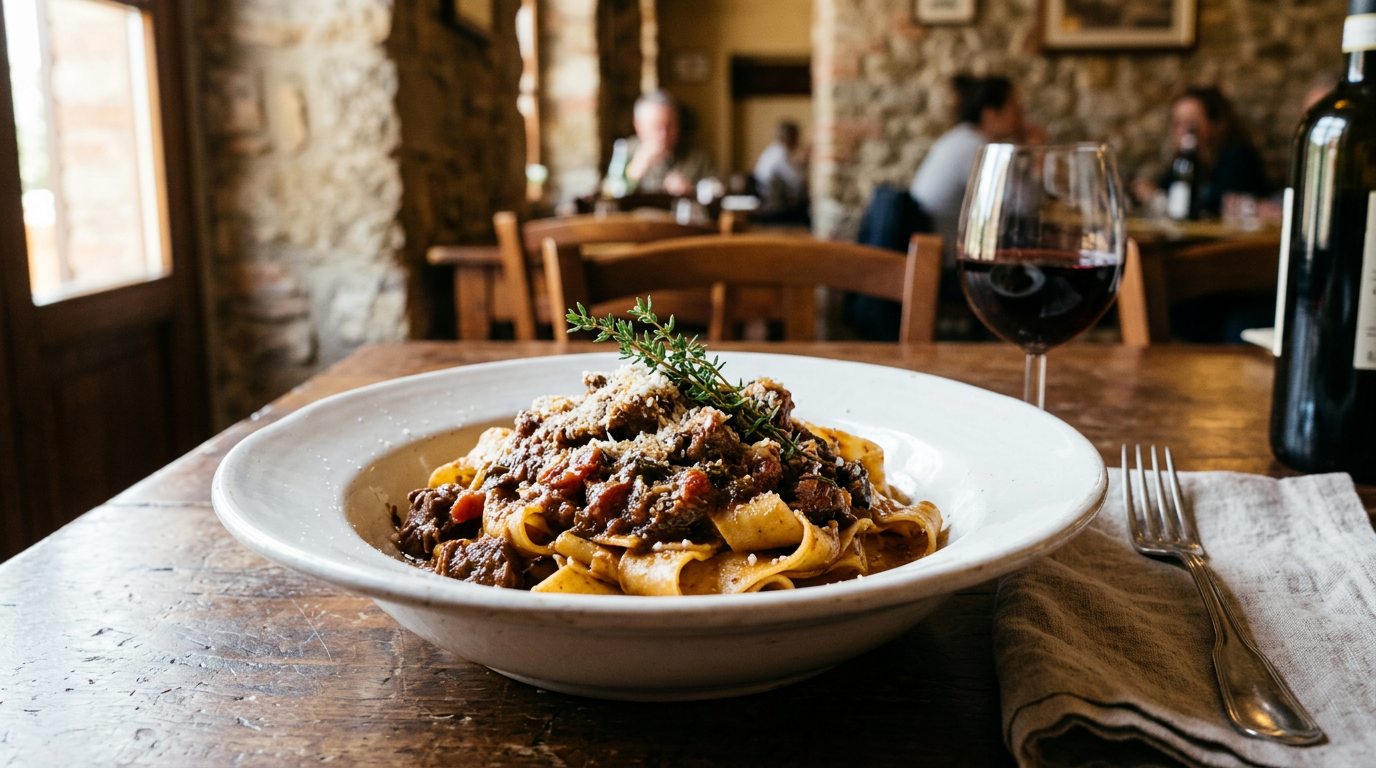
Pappardelle with wild boar: the traditional Tuscan recipe
The authentic recipe for Tuscan pappardelle al cinghiale. How to marinate the meat, make the ragù and the secret for a sauce that smells of the forest.
Wild boar in Tuscany: an ancient presence
Wild boar is as much a part of the Tuscan landscape as cypress trees and rolling hills. You see them on country roads at dusk, hear them in oak and holm oak forests, encounter them in the stories of every hunter in the region. Their presence in Tuscany is not recent - the wild boar is depicted in the Roman mosaics of the Villa di Boscoreale and in the Etruscan paintings of Tarquinia, and was already a prized quarry in medieval hunting.
In Tuscan cooking, wild boar occupies a precise and irreplaceable place. It is not an exotic or trendy ingredient - it is the meat of the autumn hunt, the kind that transforms into a ragù to cook for hours, into salumi to age in the cold months, into rich stews that smell of forest and red wine. The tradition of cooking wild boar is rooted above all in the wooded areas of Tuscany - the Maremma, the Val d’Orcia, Chianti, the hills of the Val d’Elsa.
Wild boar ragù with pappardelle is perhaps the most famous preparation. It is the quintessential autumn dish - you start eating it after the first October hunts, and continue through deep winter, when the wild boar is at its most mature and the forest has already lost its leaves. It is a dish of substance, warmth, and deep flavours that build over time.
The marinade: why it is essential and how to do it
Marinating the wild boar is not a whim - it is a technical necessity to obtain cookable meat. Wild boar (not farmed, which is much milder) has intense flesh, with a more developed muscle fibre than beef, and a flavour that can be very strong if the meat is not treated correctly.
Red wine marinade serves three functions: it softens the muscle fibres, reducing the toughness of the wild meat; it reduces the strongest and most pungent flavours of the meat; and it flavours the meat deeply with the aromatics of the marinade - garlic, juniper, rosemary, bay, cloves.
The classic Tuscan marinade: red wine (a Chianti or a mid-quality Morellino - prized wine is not used for marinating), garlic (3-4 whole cloves), juniper berries (5-6, crushed), sprigs of rosemary and bay leaves, cloves (2-3), black peppercorns (about ten), chopped onions and carrots. The wild boar meat in pieces (shoulder and leg, cut into 3-4 cm cubes) must remain in the marinade in the refrigerator for at least 12 hours, better 24. Changing the marinade halfway through is a technique used for meats with a more intense flavour.
The wild boar ragù: ingredients and cooking times
After marinating, the meat is well drained and patted dry with kitchen paper - excess water would prevent correct browning. The aromatics from the marinade can be kept - they will be added to the ragù - but the liquid is discarded.
Ingredients for the ragù for four people: 600 grams of marinated wild boar, 1 onion, 2 carrots, 2 stalks of celery, 3 garlic cloves, 200 ml red wine, 400 grams canned peeled tomatoes, extra virgin olive oil, salt, pepper, rosemary, bay, juniper berries.
Browning: the meat is browned in a pan with extra virgin olive oil over high heat, in small quantities at a time to avoid lowering the temperature. The Maillard reaction - the browning of the proteins - produces aromas that cannot be obtained any other way. This step is not skipped.
The soffritto: in a capacious casserole make a classic soffritto of onion, carrot and celery. When golden add the browned meat.
Deglazing: the red wine goes in over high heat and evaporates completely before adding the tomato.
Slow cooking: covered, over very low heat, for at least two hours. The meat must become so tender it almost crumbles spontaneously. Some chefs prefer to roughly chop the ragù halfway through cooking.
Pappardelle: how to make them or how to choose them
Pappardelle are made with an egg pasta sheet of type 00 flour and eggs - the classic proportions are 100 grams of flour per large egg. The dough is worked for a long time by hand until smooth and elastic, then rested for at least thirty minutes.
The sheet is rolled thin - about 2 millimetres - and cut into strips between 2 and 3 centimetres wide. Tuscan pappardelle are wider than Emilian tagliatelle, and this width is functional: it holds the dense ragù on its broad surface.
If buying ready-made, the best are fresh from an artisanal pasta shop. The cooking time for fresh pappardelle is brief - three to four minutes in abundant salted water. They are drained al dente - the ragù will continue to cook them during the tossing.
How to pair wine with wild boar
Wild boar ragù is an intense meat dish, with wild, spiced and earthy flavours. The accompanying wine must have structure, tannins and complexity.
Chianti Classico Riserva is the classic pairing par excellence - the Sangiovese tannins cleanse the palate of the fattiness of the meat, the acidity balances the richness of the ragù, the complexity of the wine mirrors the complexity of the dish.
Brunello di Montalcino for special occasions - a young Brunello (at least five years old) with wild boar is a combination you remember.
Morellino di Scansano as a more everyday alternative - less tannic than Chianti Classico, more accessible, but with all the necessary structure.
Autumn wild boar: the best season
Wild boar is at its best in autumn - between October and December - when it has been feeding on acorns, chestnuts, tubers and forest mushrooms. This diet is reflected in the meat: more flavourful, with an almost sweet note that distinguishes it from farmed wild boar.
During this period, Tuscan restaurants working with local wild game put wild boar on the menu with a frequency and variety not found in other months. October pappardelle al cinghiale, made with freshly hunted and marinated meat, is an experience worth the trip.
The season generally closes at the end of January. From then until summer, wild boar in restaurants is almost always farmed - still good, but different.
Want to taste it for real?
At Ristorante Alcide you will find it on the table - made the right way, with fresh ingredients and the care of the Ancillotti family since 1849.