Tuscan Pasta
Pici pasta: Tuscany's hand-rolled treasure
Pici are Tuscany's most traditional pasta, hand-rolled without eggs. History, how they are made, the best sauces and where to eat them in Val d'Elsa.
What are pici: Tuscany’s egg-free pasta
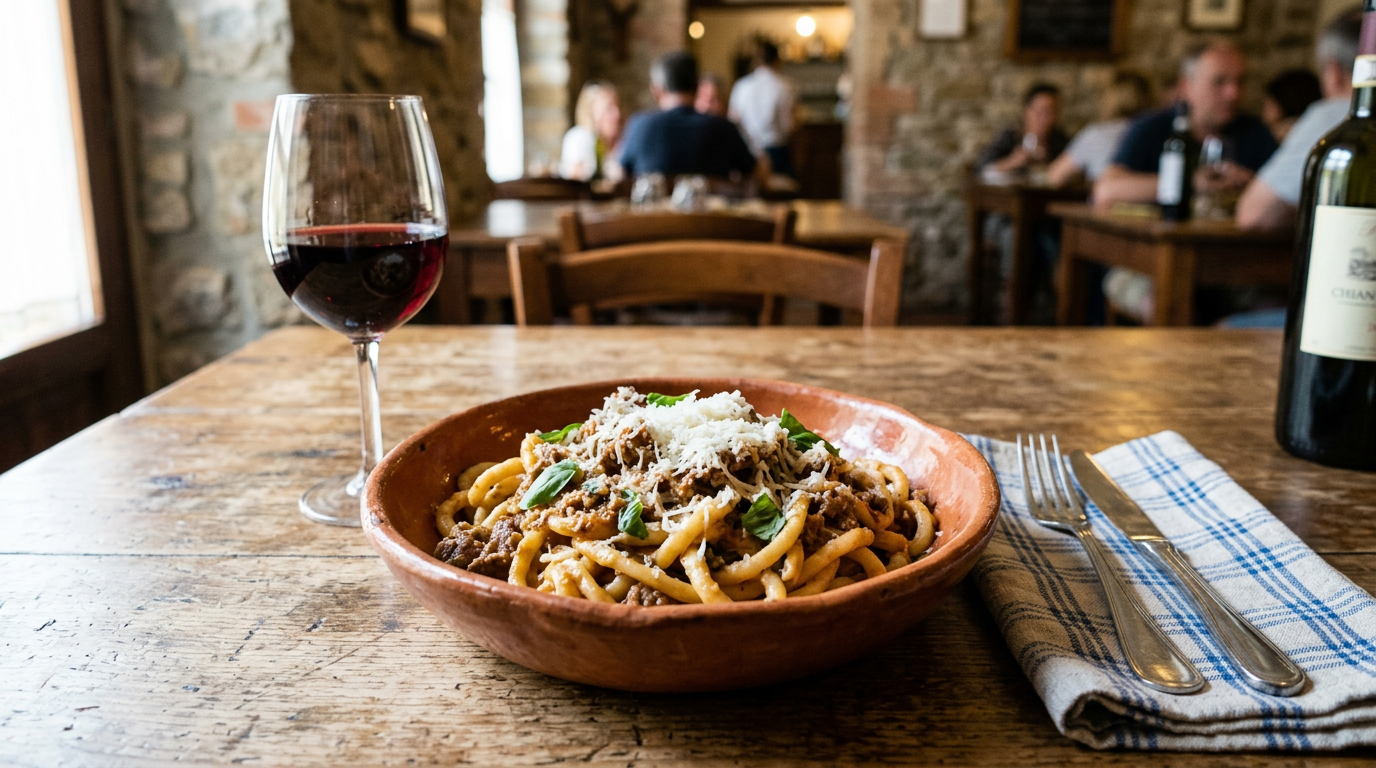
Pici are the most distinctive pasta of Tuscany - and arguably one of the most distinctive in all of Italy. They look, at first glance, like thick spaghetti: long, cylindrical, rolled by hand to an irregular thickness somewhere between a pencil and a finger. But the resemblance to spaghetti ends with the shape.
The essential difference is in the dough. Pici are made from flour and water only - no eggs. This makes them a member of the oldest and most geographically widespread pasta tradition in Italy: the Southern tradition, the tradition of the poor. Pasta made with eggs was a luxury that most Tuscan peasants could not afford for everyday meals. The chickens needed their eggs, or the eggs were more valuable sold at market. Flour and water, in the right proportions and worked with patience, were enough to make a pasta that was filling, satisfying, and capable of holding whatever sauce the season offered.
The result is a pasta with a character that egg pasta cannot replicate. Pici have a slight roughness of texture - not the silkiness of tagliatelle, but a gentle chewiness that holds sauces in a completely different way. A pici al ragù di cinghiale is a different experience from a tagliatella al ragù di cinghiale, even if the sauce is identical: the pasta participates differently in the dish, offering more resistance, holding the sauce in the curves and ridges of its irregular surface.
The history: from peasant kitchens to fine dining
Pici have been made in the Sienese countryside and in the Val d’Elsa for at least several centuries - possibly much longer, since pasta made with flour and water is ancient technology found across the Mediterranean. The earliest documented references to pici-like pasta in Tuscany date from the medieval period, and the technique has remained essentially unchanged since then.
For most of their history, pici were the pasta of the contadini - the sharecroppers who worked the land of the great Sienese estates under the mezzadria system. They were everyday food, practical food, the pasta that a woman could make in an hour with ingredients always on hand.
The shift in status came slowly, as Italian urban populations began to romanticise the rural food traditions they had previously looked down on. By the 1970s and 1980s, pici had been “rediscovered” by the Italian culinary press and by the restaurants of Siena and the Val d’Elsa as a genuinely interesting, authentically local product. Today they appear on the menus of serious restaurants across Tuscany - not as a curiosity but as one of the most requested pasta dishes, both by Italian customers and by visitors.
The artisanal pici - still made by hand, each piece rolled individually - are distinguished from the industrial versions by their irregular texture and their slightly variable thickness. The best hand-made pici have a slight undulation along their length and a roughness that industrial extrusion cannot produce.
How pici are made by hand: the technique
The technique for making pici is accessible even for cooks with no pasta-making experience, though mastering the shape requires practice. The dough is made from “00” or semolina flour and warm water, mixed and kneaded for about ten minutes until smooth and elastic, then rested under a cloth for thirty minutes.
The dough is then rolled out to a thickness of about one centimetre - not as thin as pasta for tagliatelle, but not thick either. The sheet is cut into strips about one centimetre wide, and each strip is “rolled” (pigiata, from which the name derives, meaning “pressed”) on the wooden board using both hands, working from the centre outwards in a rolling motion that thins and lengthens the strip while maintaining the cylindrical shape.
The finished pici are placed on a floured tray and allowed to rest for at least thirty minutes before cooking. They cook in a large pot of salted boiling water in about four to six minutes - longer than spaghetti because of their thickness.
The critical mistake to avoid is over-working the dough or rolling the pici too thin. A picio that is too thin will break in the pan; a picio that is too thick will be doughy at the centre. The ideal is around five to seven millimetres in diameter - thick enough to provide the characteristic chewiness, thin enough to cook through.
The classic sauces: aglione, breadcrumbs, wild boar
The classic pici sauces are among the oldest in Tuscan cooking - simple preparations that depend entirely on ingredient quality rather than technique.
Pici all’aglione: the most celebrated of the traditional pici sauces, made with aglione - a large, sweet variety of garlic grown in the Val di Chiana, distinct from common garlic in its larger cloves, sweeter flavour, and lower pyruvate content (which means it is easier to digest and less intense on the breath). The sauce is made by cooking sliced aglione cloves very slowly in olive oil until they dissolve almost completely, then adding fresh or canned peeled tomatoes and cooking for twenty minutes. The result is a sweet, garlicky, deeply savoury sauce that coats the rough surface of the pici perfectly.
Pici con le briciole (with breadcrumbs): one of the oldest pasta dishes in Italian cooking - the pasta of absolute poverty. Stale bread is dried in a low oven and ground to coarse crumbs, then toasted in olive oil with garlic, chilli and salt until golden and crisp. The cooked pici are drained and tossed with the crisp breadcrumbs. The result is surprising in its depth - the crunch of the toasted bread against the chewiness of the pasta, the richness of the olive oil, the heat of the chilli.
Pici al ragù di cinghiale (wild boar ragù): the autumn sauce, when the hunting season opens and the wild boar from the Chianti and Maremma forests arrives in the butcher shops and restaurant kitchens. The ragù is made by browning the boar meat with soffritto vegetables, then adding red wine and tomato and cooking slowly for three to four hours until the meat breaks down into the sauce. Rich, savoury, deeply flavoured - one of the great pasta sauces of Italy.
Pici vs spaghetti: why they are completely different
Visitors often ask whether pici are simply a thick spaghetti, and the answer is: no, not really. The differences begin with the dough (no eggs in pici), continue with the texture (rougher and more irregular in pici), and end with the experience at the table (pici are chewier and more substantial than even the thickest spaghetti).
The rough, irregular surface of pici creates a completely different relationship with sauce - the sauce clings to the irregularities of the pasta rather than coating a smooth surface. This is why pici work well with the coarse, rustic sauces of Tuscan cooking - aglione, breadcrumbs, wild boar ragù - where the texture of the sauce and the texture of the pasta are both rough and need to interlock.
Spaghetti, by contrast, is a smooth, regular, machine-made pasta that works best with sauces that coat evenly - olive oil-based, smooth tomato, finely ground meat. The two pastas are not interchangeable; they express different culinary philosophies.
Where to eat the best pici in Tuscany
The best pici are found in the small towns and villages of the Sienese hills and the Val d’Elsa - the territory where pici were born and where the tradition of making them by hand every morning has never been interrupted.
In Siena, the best tratttorie in the centro storico make pici fresh each morning. In the Val d’Elsa, the towns of Poggibonsi, Colle di Val d’Elsa and Certaldo all have restaurants with a genuine pici tradition. In the Val d’Orcia, Montalcino and Pienza both have tratttorie where pici are made in the traditional way.
Ristorante Alcide in Poggibonsi, active in the Val d’Elsa since 1849, serves pici made fresh each day in the kitchen - the pasta of the territory, made the way it has always been made in this part of Tuscany.
Want to taste it for real?
At Ristorante Alcide you will find it on the table - made the right way, with fresh ingredients and the care of the Ancillotti family since 1849.