Tuscan Pasta
Pici: the Tuscan pasta made by hand for centuries
Pici are the quintessential Tuscan pasta. History, how they are made and the traditional sauces of the most ancient pasta in the Val d'Elsa.
What pici are: the eggless pasta of Tuscany
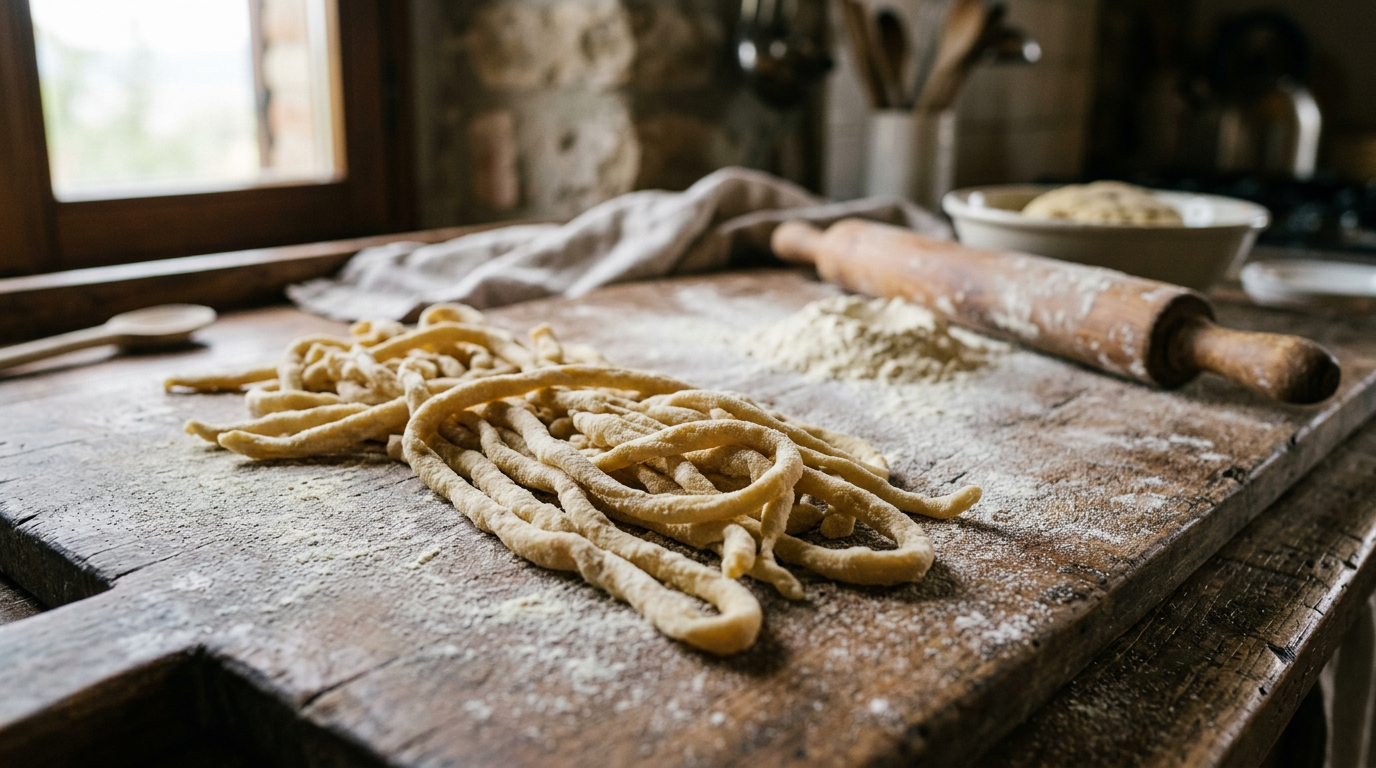
Pici are thick, irregular, hand-made spaghetti made with just water and flour - no eggs. This simplicity is at once their strength and their paradox: one fewer ingredient produces a pasta of very strong character, with a texture that no industrial or extruded version can imitate. Each picio is different from the next - some thinner, some thicker, with those imperfections that are the sign of a human hand that has worked the dough.
The shape is that of a very irregular vermicelli, between twenty and thirty centimetres long, with a diameter varying from 3 to 6 millimetres along the same piece. This is not a pasta that aims for geometric perfection - it is a pasta that embraces variation as part of its nature. That irregularity is not a defect: it is the reason why pici hold condiments differently from any uniform pasta. In the folds and thickness variations the sauce collects, breadcrumbs nestle or ragù particles settle.
The absence of eggs is a choice born of historical necessity - in Tuscan peasant cooking eggs were precious, not to be wasted on pasta when water sufficed - but it is also a choice that gives pici their own specific personality. The chewiness differs from egg pasta: more tenacious, more present in the mouth, with a note of wheat that lingers even after swallowing.
The origins of pici: a peasant history
Pici have peasant origins dating back at least to the Middle Ages, and some iconographic sources place them in Etruscan culinary practices - though this is a more romantic than documented hypothesis. What is certain is that pici are the most ancient pasta of the southern Tuscan tradition - Siena, Grosseto, Arezzo, with the strongest core in the Montalcino, Pienza and Val d’Orcia area.
The name probably derives from appiciare - to pull, to lengthen - which describes the fundamental gesture of their production. In the Sienese dialect one also says pinci or pinsare the bread (to work it), and the common root is that same manual action of pulling and lengthening the dough between the fingers.
For centuries pici were the everyday food in peasant homes. They were made on Thursdays - the traditional pasta day in many Tuscan families - with the soft wheat flour left over from the weekly milling. The condiment was whatever was available: oil and garlic, fried breadcrumbs from dry bread, a few anchovies or some garden tomatoes. No meat was needed, no rare ingredients - pici are self-sufficient.
The spread beyond peasant cooking is relatively recent: Tuscan restaurants began serving pici as a regional dish in the 1970s and 1980s, when the revaluation of Italian regional cuisine brought attention back to dishes most deeply rooted in the territory. Since then, pici have become a gastronomic symbol of southern Tuscany, present on the menus of tratttorie and restaurants throughout the region.
How to make pici by hand: the technique
Making pici by hand is one of the simplest and most meditative culinary gestures in Tuscan cooking. The dough is prepared with type 0 soft wheat flour, warm water, a drizzle of extra-virgin olive oil and a pinch of salt. The classic proportions are one hundred grams of flour to fifty millilitres of water, but the true measure comes from the hands - the dough must be firm, not sticky, elastic when folded but not rigid.
After a rest of at least thirty minutes wrapped in film - necessary to relax the gluten and make the dough easier to work - it is rolled out with a rolling pin to a thickness of approximately one centimetre, then cut into strips one centimetre wide. Each strip is taken between the palms and appiciata - rolled between the palms with slight downward and outward pressure, lengthening it until the desired thickness is achieved.
The secret is not to rush. The strip lengthens slowly, in several passes, moving from top to bottom. Those with warm hands find it more difficult - heat slightly melts the surface of the pasta and makes it sticky. Keep hands cool, work on a lightly floured surface, don’t press too hard - these are the three fundamental principles.
The finished pici are placed on a floured cloth and left to dry for half an hour before cooking them in abundant salted water. Cooking times vary according to thickness - on average six or seven minutes, but the bite decides.
Traditional condiments: from aglione to breadcrumbs
The simplicity of pici is reflected in their traditional condiments - very few ingredients, all of quality, no compromises.
Pici all’aglione: the aglione and tomato sauce is the most loved and most well-known condiment. The aglione della Valdichiana - a variety of giant garlic with delicate aroma and no bitter aftertaste - is slowly sauteed in extra-virgin olive oil, then come the tinned tomatoes, a little chilli, salt. The result is a red, aromatic sauce without aggression. It is the quintessential summer condiment.
Pici with breadcrumbs: perhaps the oldest and poorest condiment. Crumbs of unsalted Tuscan bread are toasted in a pan with extra-virgin olive oil and garlic until they become golden and crispy. The pici are dressed with abundant oil, the toasted breadcrumbs, black pepper. The contrast between the soft pasta and the crispy breadcrumbs is one of the most honest pleasures of Tuscan cooking.
Pici with wild boar ragù: typically autumnal, with a wild boar ragù marinated in red wine and slow-cooked with aromatics and tomato. A robust condiment for robust pasta.
Pici cacio e pepe: Roman influence, but the Val d’Orcia has its own tradition. Aged grated Tuscan pecorino, abundant black pepper, cooking water to create a cream.
Pici vs spaghetti: the differences that matter
Comparison with spaghetti is inevitable, but it is a comparison that pici win in their specific category - not because they are better, but because they are different in a way that strong, rustic condiments showcase.
Spaghetti - made with semolina, bronze or gold die-extruded - has uniformity and precision. It cooks in exact times, behaves predictably. Condiments distribute evenly. It is a pasta of extraordinary versatility.
Pici have irregularity and character. They cook in variable times. Condiments distribute unevenly - there are more flavourful mouthfuls and more neutral ones, and this variation is part of the pleasure. With strong condiments like aglione or wild boar ragù, pici hold up in a way that no spaghetti can match - that thick, tenacious pasta holds the sauce and carries it to the very end.
Pici at Ristorante Alcide: the version with mussels and clams
At Ristorante Alcide, in Poggibonsi, pici appear on the menu in a variation that reflects the restaurant’s marine soul: pici with mussels and clams. It is a pairing that might seem unconventional - the most rustic pasta of the Tuscan peasant tradition with seafood - but which works with surprising coherence.
The mussels and clams arrive fresh from the Tyrrhenian Sea together with the fish of the day. The pasta is hand-made every morning. The condiment is built with garlic, oil, white wine, the clam liquid that absorbs part of the sea flavour, and a fresh cherry tomato that gives freshness without overwhelming. The pici, with their thickness and tenacity, hold the marine condiment as no other thin pasta could.
It is a dish that tells Alcide better than any description - the peasant tradition of the hinterland embracing the Tyrrhenian Sea in a single plate.
Want to taste it for real?
At Ristorante Alcide you will find it on the table - made the right way, with fresh ingredients and the care of the Ancillotti family since 1849.