Cucina Povera
Ribollita recipe: regional variations and the secret of cavolo nero
All the variations of Tuscan ribollita. The secrets of cavolo nero and how to get the right consistency between soup and solid dish.
Florentine ribollita vs Sienese ribollita: the differences
Ribollita might seem a monolithic dish - one recipe, one tradition. In reality there are at least two main schools, with not insignificant differences, and then dozens of local variations that every family defends as the only authentic one.
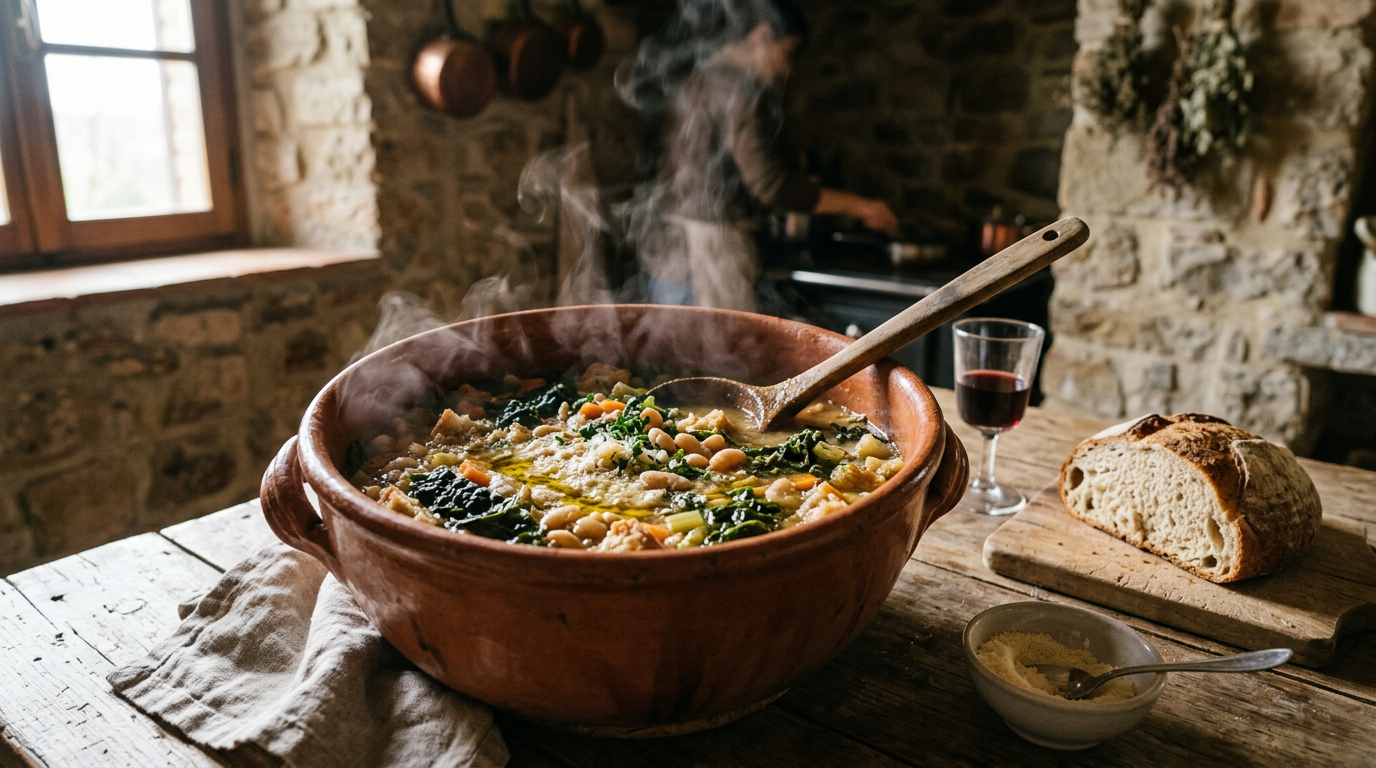
Florentine ribollita tends to be more brothy, with the bread added in moderate quantities and the vegetables maintaining a certain distinguishable consistency. Florentines often serve it as a soup - almost liquid, where you can distinguish the broth from the solids. The extra-virgin olive oil goes in a drizzle on the surface, the bread can be toasted separately and served in separate bowls.
Sienese ribollita is much denser - almost a solid dish, where the bread has absorbed all the liquid and the consistency is that of wet bread recompacted with vegetables. Some Sienese recipe books describe ribollita as something you “cut with a knife” - a hyperbole, but it gives the idea. Extra-virgin olive oil enters in abundant quantities both in cooking and as a raw finish.
Maremma ribollita often adds pork rind or a prosciutto bone for flavour to the broth - an influence from the more carnivorous kitchens of the Maremma. Some use guanciale in the soffritto.
Which version is the most authentic? It depends on where you are - and on whose grandmother has invited you to dinner.
Cavolo nero: varieties, seasonality and how to use it
Tuscan cavolo nero is a variety of Brassica oleracea that is not easily substituted with other types of cabbage. Its strap-shaped, blistered and almost black leaves have a specific aromatic profile and texture.
Seasonality is decisive: leaves harvested after the first frost (November-December) are sweeter and less bitter than summer or early autumn ones. The process is similar to that which occurs with root vegetables - cold converts starches into sugars as a mechanism to protect the plant against freezing. This does not make them sweet in an absolute sense - cavolo nero always maintains its bitter note - but it makes them more balanced and more pleasant on the palate.
How to prepare it for ribollita: remove the central rib, which is tougher and remains hard longer. The leaves are cut roughly - not too finely, because during cooking they reduce considerably - and added to the soup in the initial phase, not at the end. Cavolo nero needs long cooking (at least forty minutes) to soften and release its flavours into the broth.
A tip: if you find cavolo nero in summer, briefly blanch it, drain it, squeeze it well and store it in the freezer. It is not like fresh but is much better than not having it. Ribollita with frozen cavolo nero still has a recognisable and authentic flavour.
The beans: cannellini or borlotti?
Tradition is divided - and this time in quite a geographically clear way. The Florentine area prefers cannellini beans, white, with thin skin, which almost completely dissolve during cooking, giving the broth that characteristic creaminess. The Sienese and Maremma area uses borlotti beans more often, more flavourful with an earthy note that adds complexity to the soup.
Cannellini produce a creamier and more delicate ribollita. The broth - especially if you blend half the cooked beans and leave the puree in the liquid - becomes almost a legume veloute with vegetables, without the need for external thickeners.
Borlotti give more character, more bean flavour, an almost bitter note that balances the sweetness of long-cooked cavolo nero. They hold their shape better and give ribollita a more rustic texture.
Both choices are legitimate. The important thing is that the beans are of quality - preferably dried to be soaked, not tinned (which tends to be already overcooked and releases little flavour into the broth).
Unsalted Tuscan bread: why it is irreplaceable
In a dish that already depends so much on the quality of ingredients, the bread is perhaps the one on which it is most difficult to compromise. Unsalted Tuscan bread has three characteristics that make it ideal for ribollita.
First: no salt. Salt in the bread would interfere with the balance of the broth - the soup is salted directly, without having to contend with the saltiness of the bread.
Second: a dense and compact crumb. Unsalted Tuscan bread has little air in its crumb compared to northern bread - the crumb is almost solid. This density allows it to absorb the broth slowly and gradually, swelling without completely dissolving. More aerated bread would dissolve within minutes.
Third: neutral flavour. Bran, fermentation, salt - all of this produces aromas in northern bread that overlay the flavour of the broth. Unsalted bread is a blank canvas on which the flavours of the soup are deposited without interference.
The right consistency: soup or almost solid?
The consistency of the finished ribollita is a matter of personal taste and local tradition - but there are some coordinates.
Fresh ribollita (on the day of cooking) is still fairly brothy. The bread has swollen but the broth still has a certain fluidity. This version is lighter, easier to eat, less demanding.
The ribollita of the day after, reheated, has a much denser consistency. The bread has absorbed almost all the remaining liquid, the starches have gelatinised, the whole thing forms almost a semi-solid block that you can cut with a spoon but cannot easily pour. This is the version that Tuscans consider the real one.
The even more extreme version - used in some areas of the Sienese - involves pouring the dense ribollita into a baking dish, pressing it down, and heating it in the oven until a light crust forms on top. It is almost a vegetable and bread tart, and has a concentration of flavours that the brothy version cannot achieve.
Ribollita and wine: an unusual pairing
Pairing wine with ribollita requires a different approach from pasta or meat. The soup has a complexity of vegetables, legumes and bread that can clash with overly tannic or alcoholic wines.
Young simple Chianti - a Chianti Annata or a Chianti Colli Senesi - is the traditional and most logical pairing. Its lively acidity cleans well between spoonfuls, the light tannins do not fight with the cavolo nero, the simple fruit does not overwhelm the delicate flavours of the soup.
A fresh Morellino di Scansano, a Rosso di Montalcino, a young Tuscan red from a good local cooperative - all of these work well. Avoid the great tannic reds and very aromatic whites.
Want to taste it for real?
At Ristorante Alcide you will find it on the table - made the right way, with fresh ingredients and the care of the Ancillotti family since 1849.