Ingredients
Tuscan black truffle: where it grows and how to use it in cooking
Tuscan black truffle: seasons, harvesting areas and how to use it in cooking without making mistakes. The difference from white truffle and traditional dishes.
Truffle in Tuscany: an underground wealth
Tuscany is one of the Italian regions richest in truffles. Not only in quantity - but in variety. In the subsoil of Tuscan woods grow the prized black truffle, white truffle (among the most famous in Italy in the San Miniato area), summer black truffle (scorzone), bianchetto truffle and several other lesser-known varieties. This diversity is the result of a territory with very different microclimates - from the Tyrrhenian coast to the Apennines - and soils with highly variable compositions.
Truffle is a hypogeous mushroom - it grows underground, in symbiosis with the roots of certain trees (oak, hazel, lime, pine). It cannot be planted or cultivated in the traditional sense - the favourable context is created (by planting the right trees) but truffle growth remains unpredictable and depends largely on the year’s climatic conditions. This impossibility of total control is part of what makes truffle precious.
Truffle harvesting in Tuscany is regulated - it requires a specific licence, follows precise calendars for each variety, and takes place with the help of trained dogs (the famous Lagotto Romagnolo in Tuscany, but also Bracco Italiano and other breeds). Tuscan “tartufai” jealously guard their harvesting sites - those woods where production is consistent are passed from father to son as family heritage.
Black truffle vs white truffle: the differences that matter
The distinction between black and white truffle is fundamental - they are not interchangeable varieties either in terms of flavour or use in cooking.
White truffle (Tuber magnatum Pico): the most precious and most fragrant. It has an intense, volatile flavour with almost fermented and garlicky notes found in no other food product. The white is never cooked - it is shaved raw onto the already finished dish, because heat destroys its volatile aromatic compounds in seconds. The most famous area for white truffle in Tuscany is San Miniato (Pisa), where the White Truffle Fair is held every November.
Prized black truffle (Tuber melanosporum): less aromatic than the white, but more robust and more versatile. The black tolerates cooking - it can be added to sauces without completely losing its flavour. Its aroma is earthy, almost of the forest floor, with chocolatey notes and slight bitterness. The main area in Tuscany is Monte Amiata and the Grosseto hills.
Summer black truffle or scorzone (Tuber aestivum): less prized than the above, but much more common and much less expensive. The aroma is more delicate - almost neutral when cooked - but raw it has its own presence. It is the one that enters many industrial “truffle” products.
Harvesting areas in Tuscany
Tuscan truffle is harvested in various areas, each with its own varieties and season.
San Miniato (province of Pisa): the area par excellence for white truffle. The oak and hazel woods on the hill of San Miniato produce white truffles of excellent quality - the November Fair is one of the most important gastronomic events in Tuscany.
Monte Amiata (Grosseto-Siena): an area rich in prized black truffle. The mixed oak and Turkey oak woods of Monte Amiata produce truffles throughout the seasons, with an autumn peak.
Crete Senesi: the clay hills between Siena and Grosseto produce white truffles of excellent quality, less well-known than those of San Miniato but appreciated by local truffle hunters.
Mugello (province of Florence): an area with good production of black truffle, both prized and scorzone.
Seasonality: what can be found when
Each truffle variety has its season, and respecting it is important - not only for legal reasons but for quality.
White truffle (T. magnatum): October-December, with a peak in November. The cold of the first October nights starts the ripening - September rains are fundamental for a good year.
Prized black truffle (T. melanosporum): December-March. The quintessential winter truffle - its season is that of cold.
Bianchetto truffle (T. borchii): January-April. Less fragrant than the white but relatively abundant in Tuscany.
Summer black truffle or scorzone (T. aestivum): May-November. The longest season - it is the easiest to find and use year-round.
How to use truffle in cooking without wasting it
Truffle is an expensive ingredient, and wasting it through incorrect usage techniques is a common mistake.
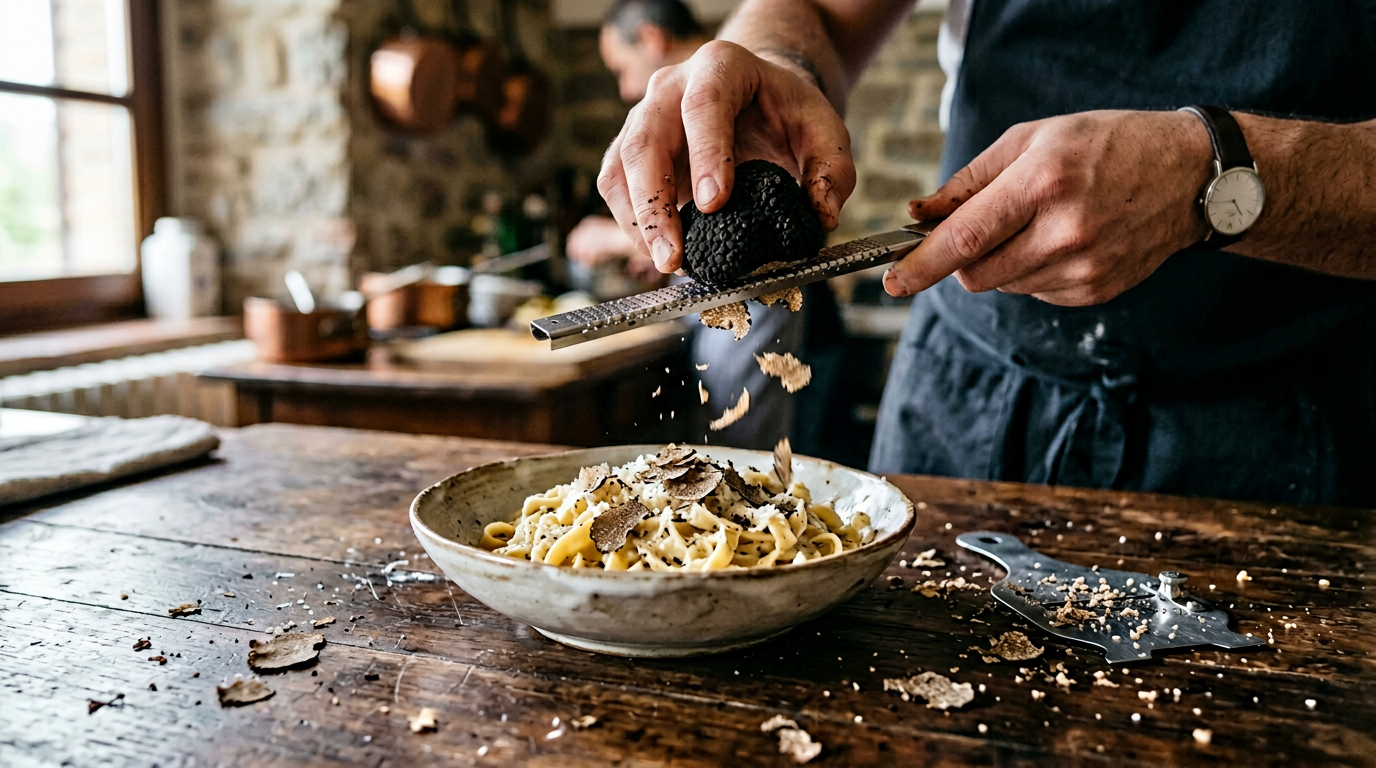
White truffle is never cooked: it is stored in the fridge wrapped in kitchen paper (changed daily), and used by shaving at the last moment onto the already plated and warm dish. The heat of the dish is sufficient to release the aromas - nothing more is needed.
Black truffle can be briefly cooked: it is added to sauces in the last minutes, or used in preparations that do not exceed 60-70°C. Prolonged cooking kills the more delicate aromatic compounds but intensifies the more robust ones.
Quantities: with white truffle, 5-8 grams per person is enough to feel its flavour significantly. With the black you need more - 15-20 grams per person in a main dish.
Pairings: truffle pairs well with neutral ingredients that showcase its flavour - eggs, fresh egg pasta, risotto, pasta with butter. Strong ingredients (tomato, abundant garlic, decisive spices) cover the truffle instead of valorising it.
Truffle and pasta: the classic Tuscan pairings
In Tuscany, fresh egg tagliolini with butter and grated truffle are the classic preparation for white truffle. The fresh pasta, the butter melting at the temperature of the dish, and the truffle aroma are a combination that requires nothing else.
For black truffle, pici with truffle sauce - butter, a drizzle of extra-virgin olive oil, finely chopped black truffle slightly warmed - are the most common preparation in Tuscan inland tratttorie during winter.
Truffle eggs - poached or scrambled eggs with slices of white truffle - are the simplest preparation and perhaps the most eloquent for understanding the flavour of white truffle without distractions.
Want to taste it for real?
At Ristorante Alcide you will find it on the table - made the right way, with fresh ingredients and the care of the Ancillotti family since 1849.