Peasant Cuisine
Tuscan cucina povera: the dishes that tell the region's history
Tuscan cucina povera is not second-rate cooking. It is the food that nourished generations. The dishes, the history and why they are back at the centre.
What cucina povera means in Tuscany
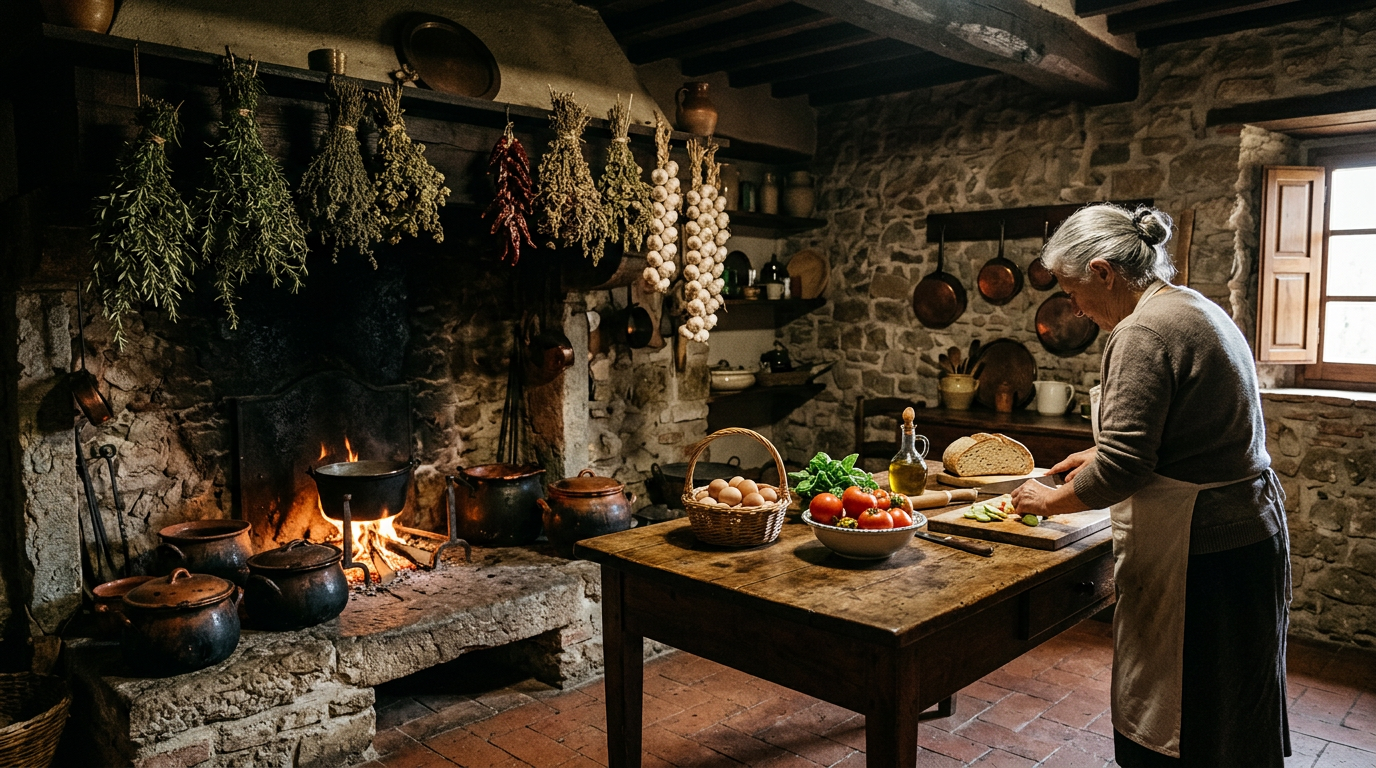
“Cucina povera” is a definition that risks being misunderstood. It does not mean low-quality cooking, inferior cooking or cooking to fill you up without pleasure. It means cooking born from scarcity - from the need to feed large families with few ingredients, to waste nothing, to transform leftovers into something good the next day. It is a cuisine that developed over centuries a sophistication of means inversely proportional to the wealth of the ingredients.
In Tuscany, cucina povera has deep roots in the social fabric of the region - a region predominantly agricultural until the mid-twentieth century, where most of the population lived as sharecroppers in the countryside, with contracts that provided for the division of the harvest with the landowner. In this context, the domestic economy of cooking was a matter of survival, not gastronomy.
What the Tuscan sharecroppers did, generation after generation, was transform this limitation into skill: they learned to use every part of the animal, every vegetable trimming, every leftover of bread in such a way that nothing was wasted and everything became nourishing and flavourful. This culture of reuse and culinary economy has produced some of the most appreciated dishes of contemporary Italian cuisine.
Pane sciocco: the foundation of everything
Tuscan unsalted bread is the common thread that connects almost all of Tuscan cucina povera. It is the base of panzanella, ribollita, acquacotta, bruschetta and dozens of other preparations. Its ubiquity is not accidental - bread was the main food of the peasant diet, and leftover bread was never thrown away.
The absence of salt in Tuscan bread has a historical explanation: salt was a taxed and expensive commodity in the Middle Ages. Unsalted bread was an economic choice that crystallised into tradition, to the point where Tuscans learned to love it that way - neutral, capable of absorbing flavours without interfering. Today Tuscan pane sciocco is a cultural identity before it is even a recipe.
The systematic use of stale bread in Tuscan cooking is planned: you do not wait for it to go mouldy before throwing it away, but plan its use so nothing is wasted. Panzanella uses it soaked in water and wrung out. Ribollita cooks it in the soup. Acquacotta places it at the bottom of the bowl under the broth. Bruschetta toasts it and perfumes it with new oil.
Legumes: beans, chickpeas and the mangiafagioli tradition
Tuscans are historically called mangiafagioli (bean eaters) by other Italian regions - a good-natured epithet that reflects a concrete culinary reality. Legumes were for centuries the main protein source in Tuscan peasant cooking, replacing meat on lean days (which were many, for religious obligations and economic necessity).
Cannellini beans are the most iconic - base of ribollita, fagioli all’uccelletto, Tuscan minestrone. Chickpeas go into the farro soup (the Lucchese garmugia), into chickpeas in zimino with chard, into the winter minestrone. Castelluccio lentils - technically Umbrian but widely used in Tuscany - form the base of the simplest and most satisfying sausage stew.
Dried beans were cooked in the oven water - placed in a glass flask with water, olive oil, sage and garlic, and left in the oven still warm after the bread had been baked. This technique - the so-called fagiolo al fiasco - gives a very gentle cooking and a creaminess that stovetop cooking struggles to replicate.
The soups: from ribollita to acquacotta
Soup is the symbolic dish of Tuscan cucina povera. Not because there was nothing else to eat - but because soup is the most efficient way to nourish many people with few ingredients, and to waste nothing.
Ribollita has already been described in detail: black kale, cannellini beans, bread. Its greatness lies in being better the next day, when the reheating transforms it.
Pappa al pomodoro is simpler than ribollita: stale bread cooked in tomato broth with garlic, basil and extra virgin olive oil. A summer dish - red, dense, fragrant with fresh basil.
Garfagnana farro soup - with local farro, beans, vegetables and guanciale - is the most widespread soup in northern Tuscany.
Maremma acquacotta is the poorest of all: celery, onion, tomato, water, and a poached egg at the end. A soup that carries the name of its essence - cooked water, water boiled with something in it.
The reuse philosophy: a habit that became a way of thinking
Tuscan cucina povera is, above all, a cooking of reuse. The leftover boiled meat becomes the cold bollito of the next day, then the polpettone, then the broth with pastina. The leftover minestrone becomes ribollita. The stale bread becomes panzanella, bruschetta, ribollita, pappa al pomodoro.
This philosophy of reuse is not nostalgic - it is very wise and surprisingly contemporary. At a time when food waste has become a global concern, Tuscan cucina povera offers a practical model of zero-waste cooking that has nothing ideological about it: it is simply the way people have always cooked when they could not afford to waste.
The contemporary recovery of this philosophy in restaurants - “root to stem” in English, “naso a coda” in Italian - is partly the rediscovery of practices that in Tuscan farmhouses have never actually stopped.
Why Tuscan cucina povera is back in fine restaurants
The paradox is evident: dishes born from poverty that today appear on the menus of the most respected restaurants in Italy, proposed by chefs who rework them with technique and awareness. How did this happen?
The answer is that Tuscan cucina povera - ribollita, panzanella, acquacotta, fagioli all’uccelletto - was never really “poor” in the gastronomic sense. It was poor in rare and expensive ingredients, but rich in technique, flavour, and coherence with the territory. When Italian and international chefs began to look at regional cooking with fresh eyes, they found in these dishes a concentration of gastronomic identity that more elaborate cuisines struggled to reach.
At Ristorante Alcide, Tuscan cucina povera is not a decorative element of the menu - it is part of the identity of the restaurant. The land dishes of the Sienese peasant tradition live alongside the sea dishes of the Tyrrhenian because both tell the same story: that of a cooking that makes no compromises on the quality of ingredients and the care in preparation.
Want to taste it for real?
At Ristorante Alcide you will find it on the table - made the right way, with fresh ingredients and the care of the Ancillotti family since 1849.