Tuscan Wines
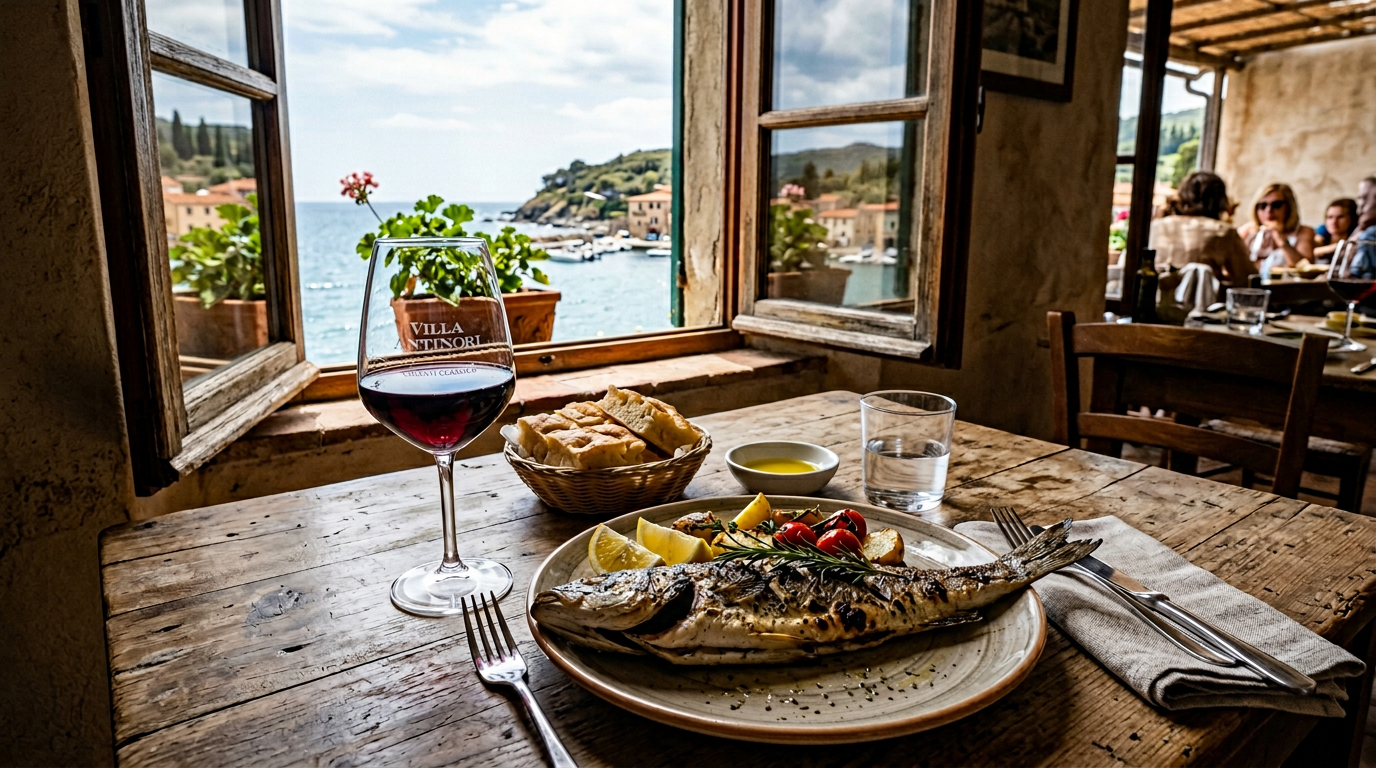
Tuscan red wine with fish: can it work?
The rule says white with fish. But in Tuscany cacciucco is drunk with red. Why it works and which Tuscan red wines hold up to fish.
The white-with-fish rule: where it comes from
“White with fish, red with meat” is one of the most widespread pairing rules in Italian gastronomic culture. Like all simple rules, it has a core of truth and an overly rigid application.
The core of truth: fish cooked simply (grilled, steamed, in foil) has delicate aromas that a fresh, mineral white wine showcases without covering. The tannins of a structured red can fight with the proteins of fish, creating an unpleasant metallic sensation. The white-fish pairing works in most cases.
The overly rigid application: the “rule” ignores that fish can be cooked in very different ways - and that cooking methods and condiments completely change the profile of the dish. Salt cod mantecato with oil and garlic is different from grilled. A fish soup with concentrated tomato and spices is different from a sea bass carpaccio. Tuscan cacciucco, with its dense red broth and complexity of spices, is completely different from a sole in butter.
Why the rule is often broken in Tuscany
Tuscany is a region that produces mainly red wines - Chianti, Brunello, Morellino, Bolgheri rosso. The Tuscan winemaking tradition is red and Tyrrhenian fish is an important component of local cuisine, especially in areas like the Livorno coast, the Versilia and the inland areas that receive fresh fish every morning.
Historically, Tuscan tables in fishing areas were set with local wine - red. Not because the pairing was considered, but because that was what was there. Over time, those combinations were refined - cooks learned to cook fish in a way that stood up to red (more concentration, more cooking, stronger flavours), and wine producers learned to make reds with the right structure.
The result is a tradition of red-fish pairings that has its own internal logic and territorial coherence.
Cacciucco and red: an established tradition
Cacciucco alla livornese is the most emblematic case of red-fish pairing in Tuscan cuisine. It is not a pairing proposed by modern sommeliers as a challenge to conventions - it is what has been done in Livorno for generations.
The reason is structural: cacciucco already has red wine in it (in the soffritto base, for deglazing). The concentrated tomato, the chilli, the long cooking that reduces and thickens the broth - all of this produces a dish of intensity that no ordinary white wine could hold up to. A young Chianti, with its fruity acidity and moderate tannins, behaves in cacciucco as it does with bistecca - it cleanses, balances, dialogues.
The Livorno tradition is almost rigorous on this point. The preferred pairing in the port restaurants of Livorno is Chianti or Morellino, not Vernaccia or a structured white. Those seeking confirmation can stop at the oldest tratttoria of the Livorno fish market and observe what regular customers are drinking.
Which Tuscan red wines work with fish
Not all Tuscan reds pair well with fish. The main variable is tannic structure - the more aggressive the tannins, the less compatible with fish.
Young Morellino di Scansano: the best red-fish pairing in Tuscan cuisine. Morellino has soft tannins, fruity acidity, a medium body that does not overwhelm the fish but accompanies it. With cacciucco, with braised cuttlefish, with stuffed squid - it works.
Simple Chianti Annata: lively acidity, non-aggressive tannins, light fruit. With fish dishes cooked in a more intense way (alla puttanesca, in tomato sauce, with olives) they hold up well.
Rosso di Montalcino: a younger and less tannic version of Brunello. With cacciucco it is an interesting option - more structure than Morellino, but less aggressive than Brunello.
Bolgheri rosso (blend with Cabernet or Merlot): Cabernet tannins tend to be more aggressive with fish. Better in soft blends where Merlot dominates.
The red wines to absolutely avoid
Young, un-decanted Brunello: tannins too aggressive, they fight with the proteins of fish. Only very mature Brunello (ten years and more) could work with a very robust cacciucco.
Barolo and Barbaresco: Nebbiolo is rich in tannins that with fish create an unpleasant metallic sensation.
Cabernet Sauvignon in purity: herbaceous, tannic, does not pair with practically any fish dish.
Amarone della Valpolicella: powerful, alcoholic, very tannic. Completely inappropriate with fish.
Any very young and tannic red not yet integrated: green tannins are the worst partner for fish.
The practical rule: follow the territory, not the manual
The most useful rule for pairing wine with fish - and which is particularly valid for Tuscany - is to forget abstract rules and follow the territory.
In Tuscany, seafood is cooked with red wine in the cooking. Concentrated tomato enters fish soups. The spices are those of the Mediterranean countryside - garlic, rosemary, chilli. These are flavours that call for a moderately structured red wine, not a mineral and delicate white.
At Ristorante Alcide, where cacciucco and Tuscan fish dishes coexist with the land dishes of the Sienese tradition, the wine list is built taking this dual identity into account. Morellino di Scansano is the recommended red with the most intense fish dishes; Vernaccia di San Gimignano is the territorial white for the more delicate fish. Both come from less than fifty kilometres away.
Want to taste it for real?
At Ristorante Alcide you will find it on the table - made the right way, with fresh ingredients and the care of the Ancillotti family since 1849.