Tuscan Wines
Tuscan wine and food pairings: a practical guide
Which wine with ribollita? And with cacciucco? A practical guide to pairing Tuscan wines with traditional dishes - without rigid rules.
The key principle: territory pairs with territory
Before any technical rule, there is a simpler and more reliable principle: wines and dishes from the same territory tend to pair well together. Not always - there are exceptions - but as a starting point it is the most honest.
The reason is historical rather than scientific: in every territory, local wines developed over centuries alongside the local cuisine. Producers drank their wine with the dishes of their own tradition, and the combinations that worked became established. Those that did not work disappeared from common practice. The result is a natural selection of pairings that reflects the real compatibility between products of the same territory.
In practice: with Sienese cooking, drink Sienese wines (Chianti Colli Senesi, Brunello, Rosso di Montalcino). With Chianti cuisine, drink Chianti wines. With fish dishes from the Tyrrhenian Sea, drink Vernaccia di San Gimignano or Morellino di Scansano. This guide does not replace personal experience, but it is a reliable starting point.
Chianti Classico: what it actually goes with
Chianti Classico is the most versatile territory wine in Tuscan cuisine - and this versatility comes from its structure: medium-high acidity, tannins present but not aggressive in the Annata versions, cherry and plum fruit.
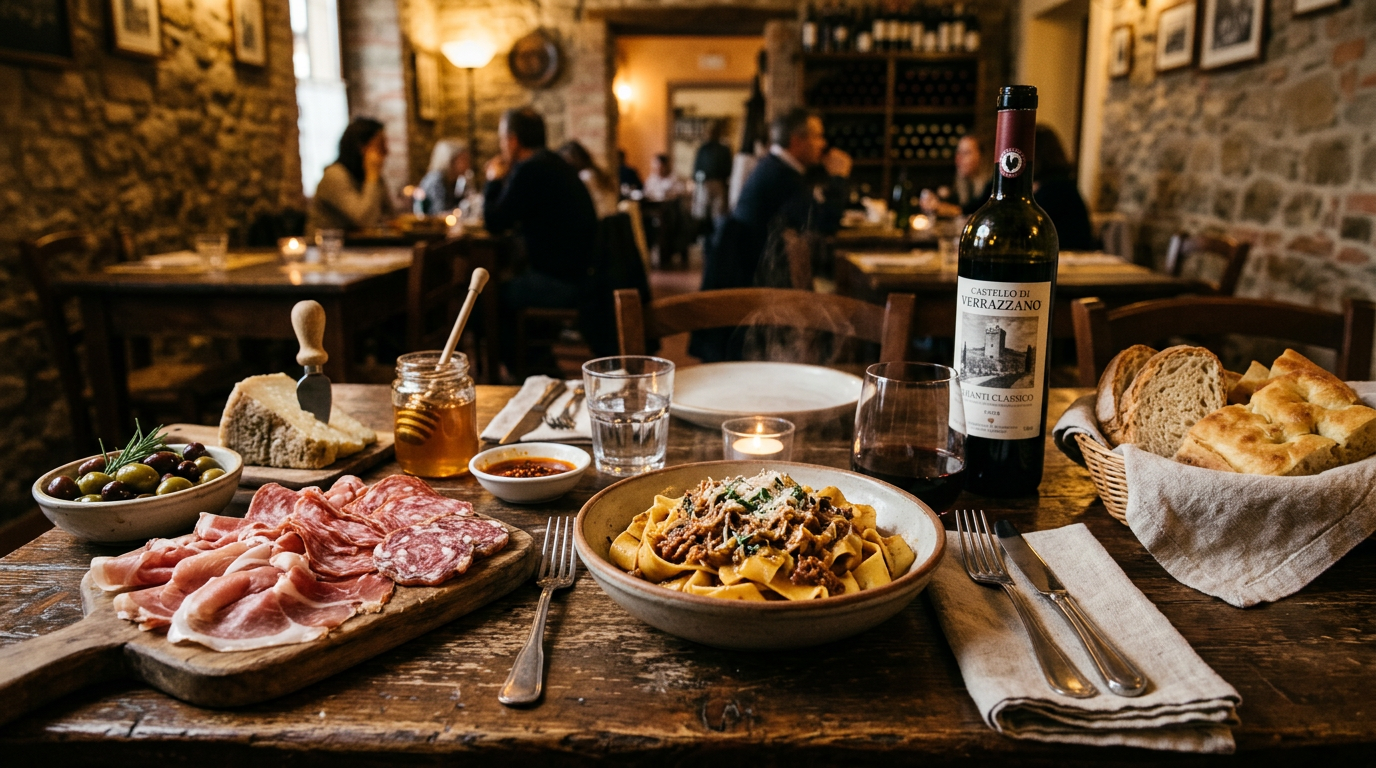
Perfect pairings: Chianina bistecca fiorentina, pappardelle with wild boar ragù, pork roast with rosemary, winter ribollita, cannellini beans with sausage (fagioli all’uccelletto), aged Pecorino Toscano.
Pairings that work: pici with meat ragù, tagliolini with clams (with a lighter Annata version), chicken liver crostini, tripe alla fiorentina.
Avoid pairing with: delicate grilled fish, sea bass carpaccio, raw seafood - Chianti Classico is too structured for these dishes.
The progression rule: with Chianti Classico, the wine level matches the dish level. Annata with everyday dishes, Riserva with important dishes, Gran Selezione for special occasions.
Vernaccia: beyond fish
Vernaccia di San Gimignano is often presented only as a fish wine - a pairing that works but is reductive compared to its full possibilities.
With fish: the most natural pairing. Clams, grilled sea bream, light fish soup, cuttlefish in white sauce - the standard Vernaccia is the quintessential Tuscan territory white wine.
With seafood pasta: tagliolini with clams, spaghetti with surf clams, bavette with prawns - Vernaccia enhances marine flavours without overwhelming them.
Less obvious choices: Vernaccia Riserva with cacciucco (if you prefer not to go red), with seafood risotto, with chicken liver terrines - the slight bitterness on the finish balances strong flavours well.
Positive surprises: standard Vernaccia with fresh Pienza Pecorino, with liver crostini, with olive oil-gratin vegetables - local pairings that work better than they might seem.
Brunello and Vino Nobile: when to open them
Brunello di Montalcino and Vino Nobile di Montepulciano are occasion wines - opened when the dish warrants it and when you are prepared to pay attention.
Brunello: aged Chianina bistecca, braised wild boar, hunter-style hare, game of all kinds, Pecorino aged 18 months. Do not waste a Brunello on simple dishes - not because it is harmful, but because the wine has too much to say and the dish too little.
Vino Nobile di Montepulciano: less extreme than Brunello, more accessible, with a similar aromatic profile but less imposing structure. Excellent with mid-effort Tuscan meat: Chianina roast, pork ribs with rosemary, wild boar pâté on bruschetta.
When not to open them: never with delicate fish dishes, never with simple tomato pasta, never when you do not have time to appreciate them.
Morellino di Scansano: the underrated wild card
Morellino di Scansano is perhaps the most underrated Tuscan wine in terms of food pairing - often considered only as an economical alternative to Chianti Classico, it actually has specific characteristics that make it superior for certain pairings.
Its soft tannins and notes of Mediterranean scrubland (rosemary, thyme, aromatic herbs of the Maremma) make it particularly suited to:
Fish in unconventional ways: cacciucco, cuttlefish stewed in tomato, octopus alla maremmana - red-with-fish pairings that are tradition on the Maremma coast.
Maremma meat tradition: wild boar on the spit, porchetta with herbs, pork roast with garlic and rosemary.
Tuscan charcuterie: finocchiona, Tuscan salame, Tuscan prosciutto - the softness of Morellino balances the fat of cured meats well.
Young sheep cheeses: a fresh Morellino with a fresh spring Pecorino is a simple, almost perfect territorial pairing.
The final rule: trust your palate
Pairing guides and rules are useful as orientation - not as prescriptions. Everyone’s palate is different, and personal experience counts more than any enological theorem.
The most important thing is this: when you find a pairing that works, remember it and repeat it. When something does not work, understand why and learn from it. Over time you build a personal repertoire of pairings that is more reliable than any guide - because it is based on your own experience, not someone else’s.
At Ristorante Alcide, the wine list is built with this spirit: not to impress, but to suggest concrete pairings with the dishes on the menu. The dining room staff can advise - and if you ask, you receive a precise and reasoned answer, not a vague one.
Want to taste it for real?
At Ristorante Alcide you will find it on the table - made the right way, with fresh ingredients and the care of the Ancillotti family since 1849.