Cacciucco
Where to eat cacciucco in Tuscany (and why inland)
Where to find the best cacciucco in Tuscany? Not only in Livorno. A guide to restaurants that make it really well, including in the interior.
Cacciucco is not only from Livorno
There is a deep-rooted belief among travellers approaching Tuscan cooking: good cacciucco is only eaten in Livorno, at the port, with the smell of the sea a few metres away. It is an understandable belief - the dish was born there, the fishermen invented it there, the city has made it its own with an almost municipal pride. But it is also a belief that ignores how cuisine actually functions in Tuscany.
Cacciucco spread into the Tuscan interior long before motorways existed. Families moving between the coast and the countryside brought their recipes, methods and tastes with them. The fish markets of Livorno and Viareggio served not only coastal restaurants but also wholesalers and tratttorie in the interior. The tradition of sea fish in the Tuscan interior is at least two centuries old - and in some areas, such as the Val d’Elsa, it is an integral part of the local gastronomic identity.
The real question is not “where in Tuscany” but “in which restaurant” - regardless of where it sits on the map.
The fish tradition in the Tuscan interior
The Val d’Elsa, which extends from Florence towards Siena passing through Certaldo, Poggibonsi and Colle Val d’Elsa, has a long history of inland seafood cooking. It is one of the richest areas of medieval Tuscany - commerce, pilgrims on the Via Francigena, noble families with their refined kitchens. Fresh fish, carried on mule-back or by fast carts from the Tyrrhenian ports, was a prized ingredient in the kitchens of the great houses and monasteries.
With the twentieth century and industrialisation, the tradition partially crystallised in the historic restaurants of the area - establishments founded in the nineteenth century that kept the connection with the Tyrrhenian ports alive. Not as folkloric curiosity, but as a precise commercial and identity line.
Cacciucco in the interior is not a copy of the Livornese version. It is a territorial variant - using the same fish, the same basic techniques, but with the sensibility of a kitchen that lives the complexity of Tuscan land and sea flavours together.
What to look for in a good restaurant cacciucco
When ordering cacciucco at a restaurant, there are certain signs that allow you to distinguish a carefully made dish from one prepared without attention.
The broth: must be dense and dark, almost a sauce. Watery and pale broth indicates abbreviated cooking or excess water. The intense brick-red colour comes from tomato slow-cooked with the fish - it cannot be imitated with colouring or excess tomato.
The fish: must be recognisable. A good cacciucco presents whole or large pieces of fish, not an indistinguishable mixture. Seeing a slipper lobster cut lengthwise on the surface, or a piece of octopus well-cooked but not falling apart, is a good sign.
The bread: rubbed with fresh garlic, toasted, not rubbery. If the bread is soft shop-bought bread crumbled into the broth, it is a negative signal.
The variety: a cacciucco with three types of fish is thin. It does not necessarily need to contain seven varieties, but the complexity of the broth depends on the variety of species - and in a good cacciucco you can sense this.
The price: a cacciucco made with quality fresh fish cannot be cheap. If a restaurant is selling it for less than 18-20 euros, it is fair to wonder what they are really using.
Alcide’s cacciucco in Poggibonsi: the story
Ristorante Alcide opened in 1849 in Viale Marconi in Poggibonsi, at the point where the Val d’Elsa narrows between hills looking towards Siena. The Ancillotti family has kept the tradition of Tuscan land and sea cooking alive for nearly two centuries, and cacciucco is one of the dishes that best represents this dual soul.
The choice to serve fresh Tyrrhenian fish in a restaurant forty kilometres from the sea was never a commercial gimmick. It was, from the beginning, a statement of identity: Poggibonsi is in Tuscany, Tuscany has the sea, the sea is as much a part of Tuscan cooking as bistecca and ribollita. Alcide’s cacciucco is not exotic - it is Tuscan.
The fish arrives every morning from Livorno and Viareggio, selected directly from suppliers with whom the restaurant has built relationships over decades. The species change with the season and with what is available from the catch - there is no standardised cacciucco on the menu all year, but a dish that responds to the reality of the Tyrrhenian Sea week by week.
How to book and when to go
Cacciucco at Ristorante Alcide should be reserved in advance. Not because the restaurant is hard to find or inaccessible, but because it is a dish that requires preparation - the fish is purchased in the morning, the cooking has its timing, and it cannot be improvised on last-minute request.
Booking is done by phone or through the form on the website - specifying that you want the cacciucco, so the kitchen knows how to organise in advance. The restaurant is open for lunch and dinner, with hours that vary between seasons.
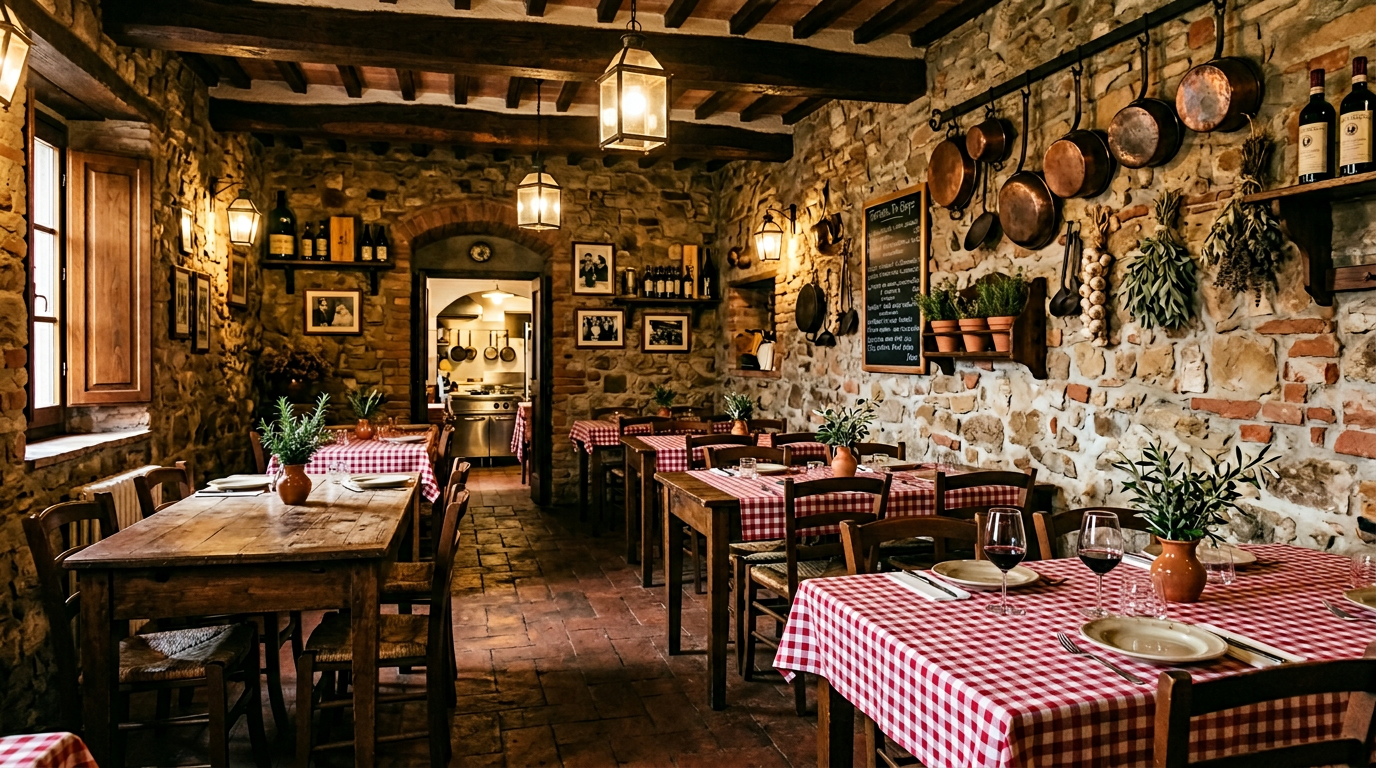
The best time to eat cacciucco is autumn and winter - when the Tyrrhenian fish is at the best of its season, the cold outside makes the hot broth even more comforting, and the restaurant dining room has that warm, gathered light that inland seafood dishes deserve.
Want to taste it for real?
At Ristorante Alcide you will find it on the table - made the right way, with fresh ingredients and the care of the Ancillotti family since 1849.